Holy Trinity Church
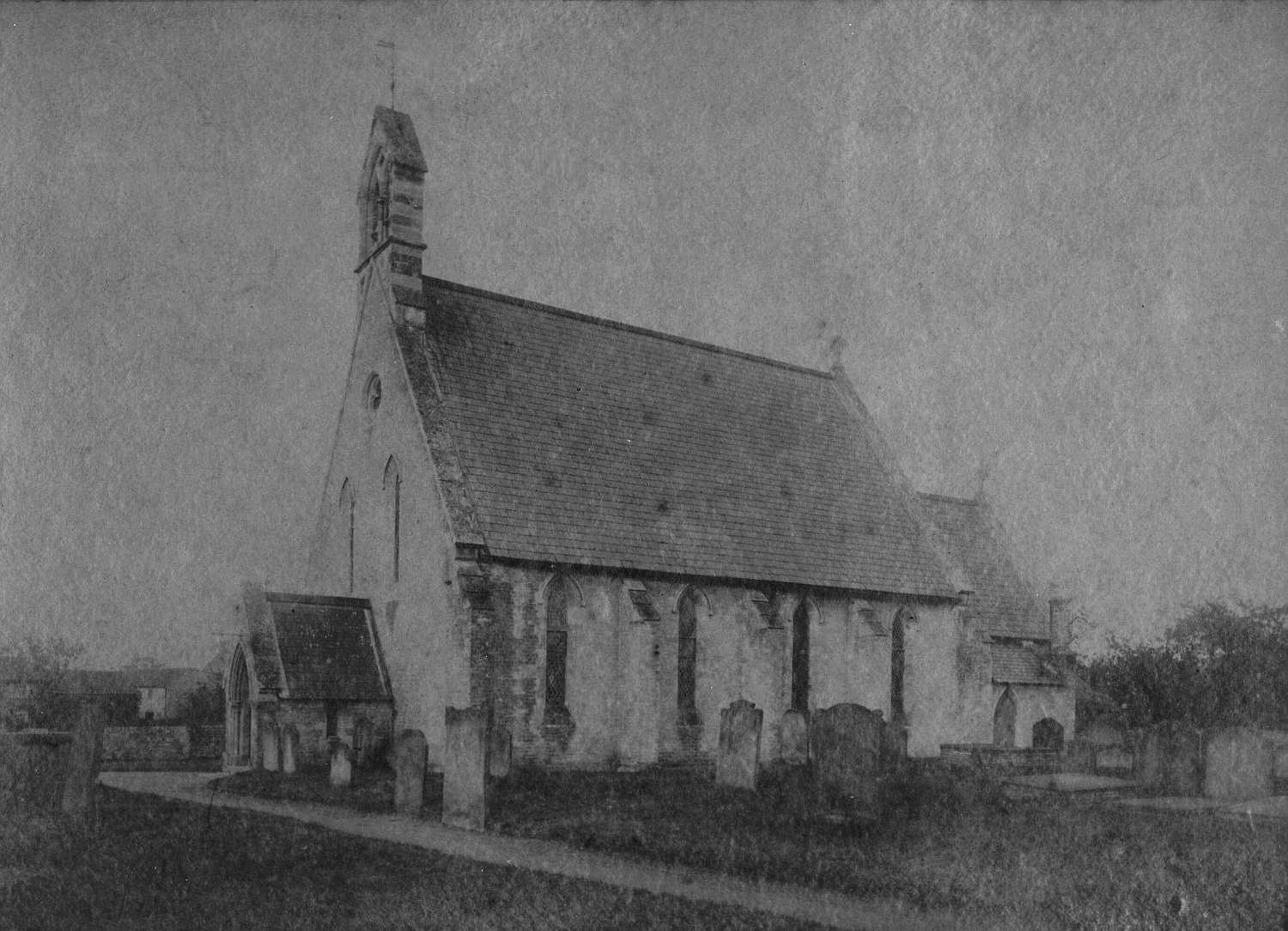
The church before its rebuild in 1895
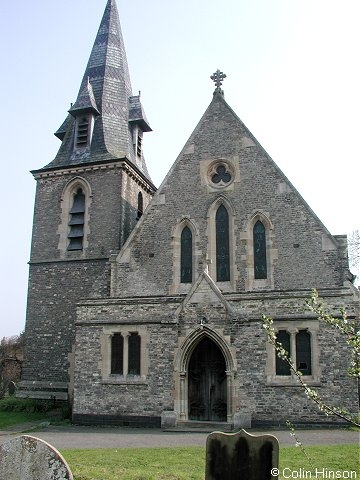
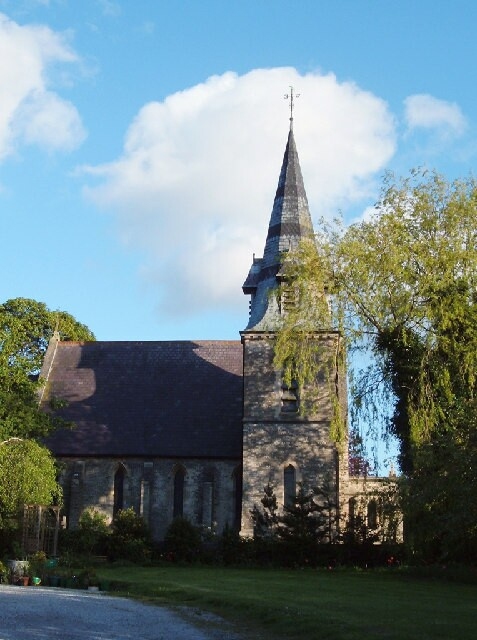
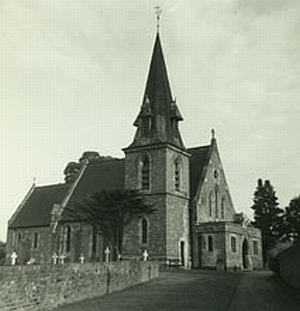


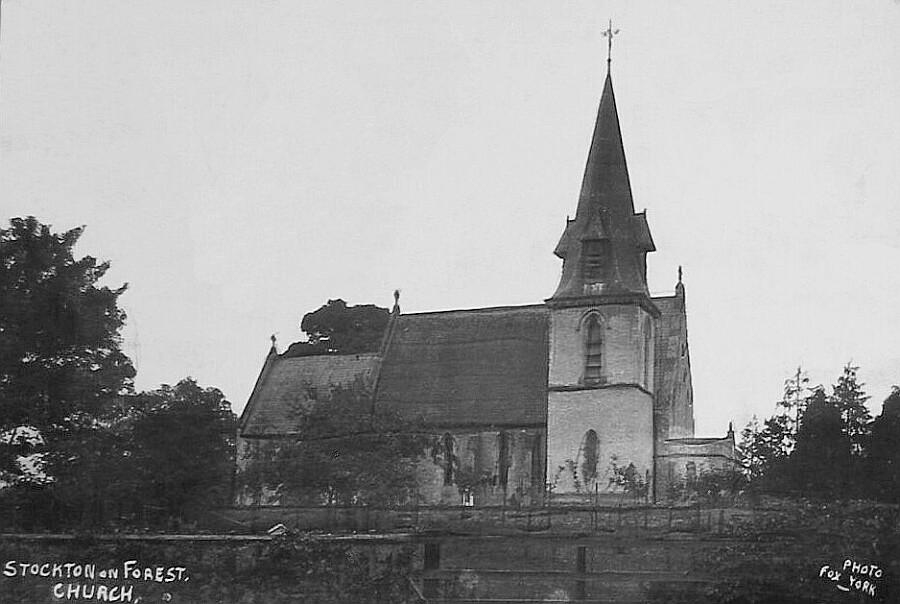
C1909 Fox took a number of photographs of the village which were released as postcards.
Primary School project photos from 1986 - very poor quality.
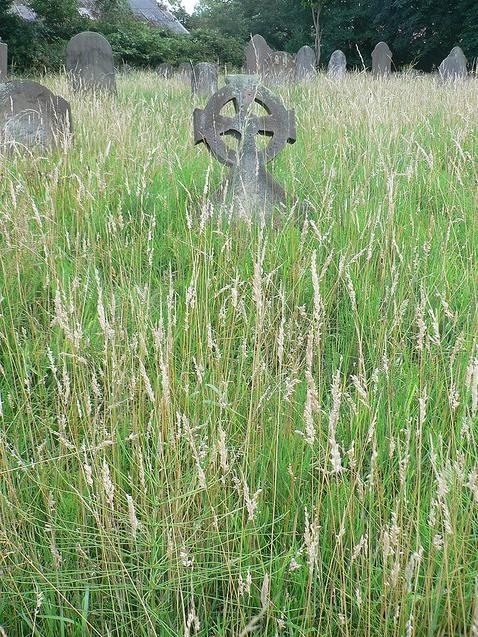
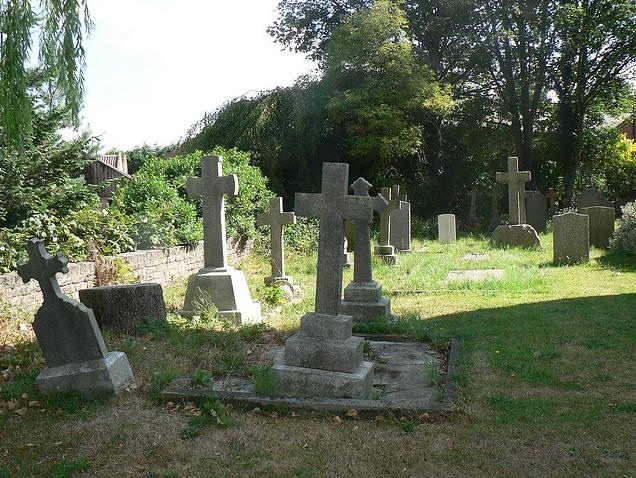 July 2006
There is no record of a church in the Doomsday Book (1086), where everthing was described as waste; but there is believed to have been a religious presence in Stockton around 1080 in the form of a chapel, suggesting that it was not administered from within the village but from a 'mother' church probably in the prebendary of the Canon of Bugthorpe.
The first known mention of a church building in Stockton is in 1276 when the Archbishop of York first granted tithes from land in Sandburn, Carlton and Stockton to the Chapel at Stockton. The land was newly brought back to an arable state after being laid waste in 1069 in the 'Harrying of the North'.
The administration of York Minster was being reformed by Archbishop Thomas who created a large number of canons to run the Minster. These canons were made rectors of village churches whose prebend (salary) was often augmented by other churches. Thus Stockton was in the prebendary of the Canon of Bugthorpe, who remained rector of Bugthorpe while also receiving the financial benefits of the chapel in Stockton: a mill and tithes in Stockton, the farm of Marton and a manor house in the city of York, which in 1291 had a value of £40. In return for these benefits he had to provide a church building, always called a chapel, and an assistant priest for services there, a situation which continued until 1840.
Unfortunately the Canon(s) did not take much care of Stockton and spending was meagre leading to many complaints. In his visitation of 1615, Archbishop Toby Matthews, found the Stockton chancel in a ruinous state, the roof lacking tiles and many windows broken.
In 1738, and again in 1788 and 1810 the church authorities allocated the rents of certain lands in Aughton-on-Derwent, Castleford and elsewhere, to pay the priest in Stockton, but still in 1743 Archbishop Herring found that services were held only once a fortnight and were taken by the Rector of St Margaret's, Walmgate, York.
Archbishop Herrings Visitation Return of 1746 records that there was a private school in the village run by a man who taught "English, writing & Arithmetic, and takes Care to instruct children in the Church Catechism. By 1764 and Archbishop Drummond's Visitation Return there was no school endowed but a schoolmaster was occasionally hired and supported.
Archbishop Drummond's Visitation Return for 1764
Original church was a medieval structure that was destroyed and replaced in 1808 by a church of 13th century Gothic style characterised by a medieval spire. (I have seen comments made that the rebuild in 1895 was due to the medieval base of the early 19th Century rebuilds so the 1808 church my have just been a reface rather than a new build.)
The Pews War of 1812 which followed the installation of pews during this rebuild.
By 1840, the chapel was again in a dilapidated condition and Archbishop Edward Vernon-Harcourt terminated the connection with Bugthorpe, and appointed a priest.
In 1843, the nave of the church was rebuilt in the Early English Gothic style, consistent with the medieval chancel and carried out in white brick with stone facings. This cost £650, a small sum even for those days and the whole village helped with the transport of material and in other ways to keep costs down. Benjamin Agar of Brockfield gave £100 and George Lloyd of Stockton Hall contributed the rest.
The architect was George Townsend Andrews of York, who's work was to return to the village a few years later when Warthill station was built to his design for George Hudson's Y&NMR.
In 1850 the church was described as a neat building in white brick covered with slate in a harmless Lancet / neo Gothic style consisting of nave and chancel, with an entrance porch at the west end, which had a circular window, over which was a gable belfry hung with two bells weighing less than 56 lbs (25kg) each.
In 1851 in addition to the Census of Population a census was taken of all identified places of worship requesting a return of seating, attendance on Sunday 30th March and other questions.
The information provided by JG Fawcett, Incumbent, Stockton House, York, was that St Andrew, SofF was an ancient chapelry, consecrated before 1800. It had an endowment of £29 from the land, £0.6.3 tithe, £80 glebe, £28.12.0 from other permanent endowments and £1 in fees. It had sittings for 240 being 86 free and 154 other. The average attendance over the past year on a Sunday in the morning was 90 general congregation and 62 sunday school and in the afternoons 130 general congregation and 62 sunday school. On the 30th March the actual figures were morning 69 general congregation and 43 sunday school and in the afternoon 112 general congregation and 43 sunday school. Rev Fawcett stated that "Influenza is prevalent & has caused many to absent themselves from Church today."
Report to the House of Commons on church expenditure for the year ending Easter 1864
At start of 1863 the parish brought forward the sum of £2 15s 4d from the previous year. They collected rates (at common law) of £11 5s 1d giving total receipts of £14 0s 5d.
They spent £1 14s 8d on ordinary repairs of church or churchyard; £8 19s 1d on the maintenance of the Public worship; £1 14s 4d on Other Payments; a total expenditure of £12 8s 1d leaving a balance at the end of the year of £1 12s 4d.
A parsonage house was provided for the first time in 1865 and two years later the Ecclesiastical Commission declared the parochial chapelry of Stockton to be a rectory.
On Easter Sunday in 1871 at the morning service in one pew there were sat 5 men whose total age was 385 years, an average of 77 years each . Three of these fathers of the hamlet were 78 years old, one 77 and the other 74.
Until well past the middle of the 20th century, the fortunes of the church revolved round such families as the Agars of Brockfield, the Lloyds of Stockton Hall, the Rawdons of the Hermitage, and the Barstows of Hazel Bush (Capt Lewis Barstow, RN had married Mary Anne, elder daughter of John Agar). The Agars were Lords of the Manor, but Brockfield was distant from the village and the Lloyd family of Stockton Hall came to take a lead in village matters.
Alicia Maria Lloyd was a great benefactress to the church and village. In 1856, using an older charity of Susanna Wilkinson which provided for the free teaching of 10 scholars, she erected a handsome schoolhouse with a master's house attached.
Village life was further enriched by the establishment in 1856 or 1886 of a Church Institute with reading room and lending library, and in 1893 came the building of the Parish Room. The rector of Stockton, Rev William Gell, was at the centre of these activities, strongly supported by the Agar and Lloyd families and the rest of the village.
Village co-operation is well illustrated by the wrangle between the two Agar sisters, Mrs Mary Anne Barstow and Miss Harriet Elizabeth Agar, and Rev Henry Hassard in 1878. The two sisters as joint Lords of the Manor objected strongly to the Rector's rearrangement of the chancel, since this bought the Agar family pew face-to-face with pews occupied by workers on the Brockfield Estate. The matter went to the Archbishop's consistory court and was decided in favour of the Agars because of a giant petition from all in the village (except one family), supporting the Agars' objection.
In 1890 the church was again ruinous and out of commission but the village population was growing so the Rev William Gell drew up plans to enlarge the nave and rebuild the chancel entirely. Early ideas by Temple Moore were rejected as 'something queer', and more orthodox ones by Naylor & Sale of Derby accepted.
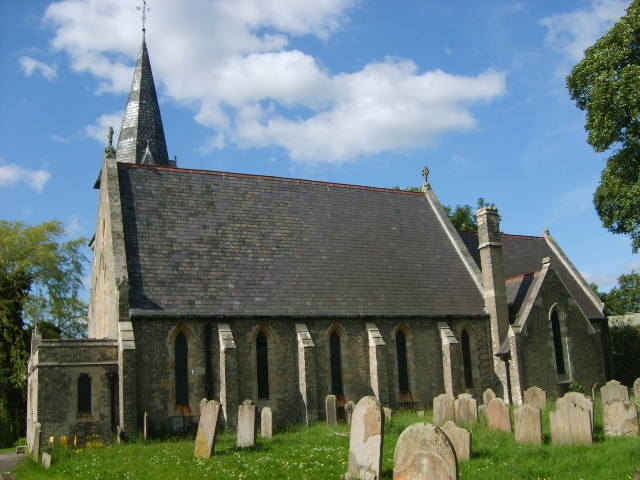
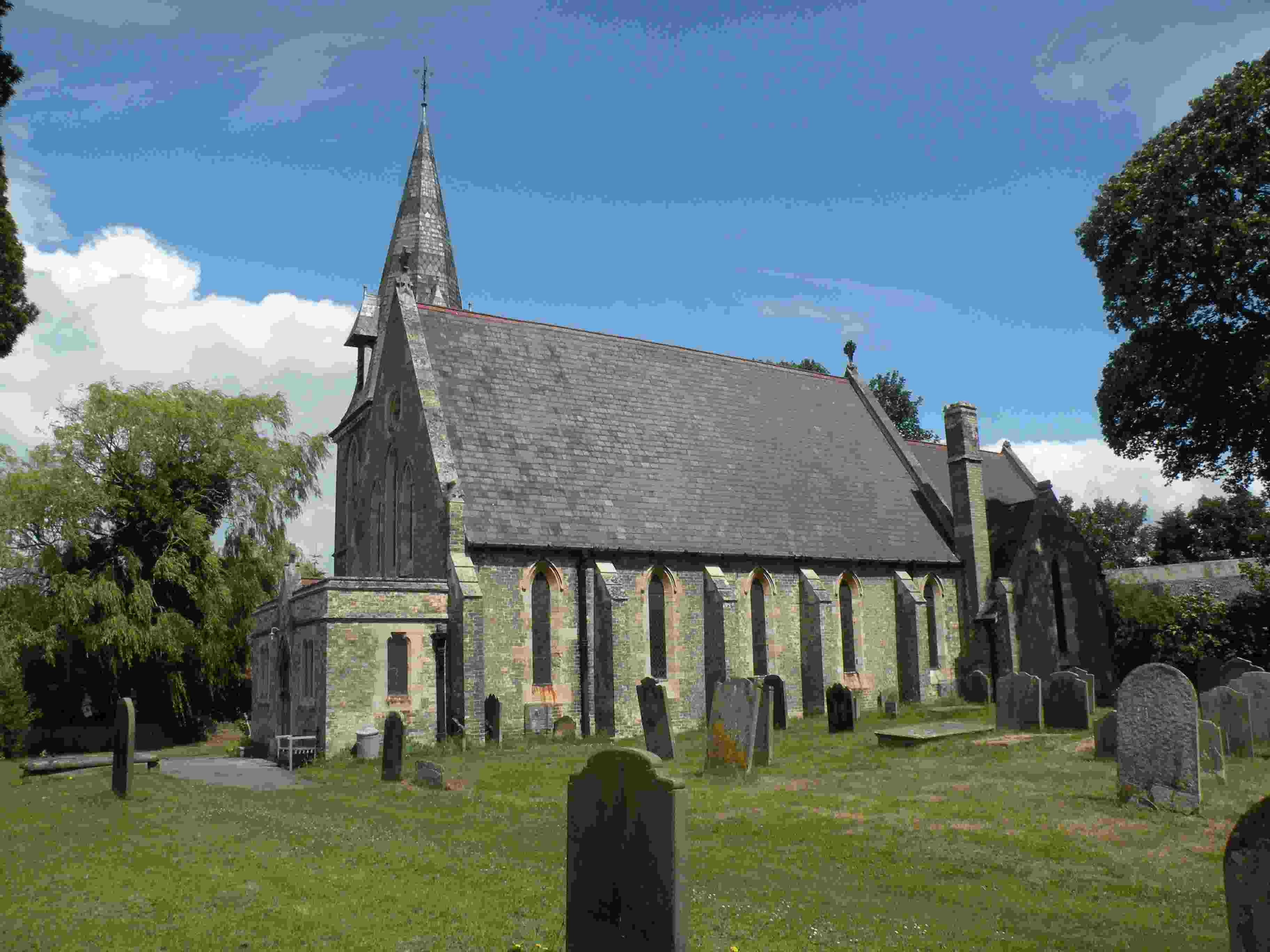
The work was started in 1894 and retained the white brick with stone dressing style of 1843 and the nave was retained but extended one bay eastwards. A completely new chancel was built and the West gallery, the West wall and the bell gable were demolished. A baptistery and clergy vestry were added to the South and North of the existing porch. There were plans to have been transepts and an apse to the baptistery, but these were abandoned, although the organ chamber acts as a miniature South transept. Lancet windows were inserted in the new West wall and a new bell-tower built on the north west side with a slate covered steeple, of the same height, above. Since the brunt of the £2500 cost was borne by the Agar sisters, the arms of the Agar family are to be found on the East gable of the chancel. But there were other contributors, including the Lloyds of Caythorpe Hall, the Palmes of Naburn, the Duke of Sutherland and the Archbishop of York. There was seating for 220.
Opportunity was taken to renew the main fitments of the church, and the major donations were:
Altar crosses, vases and candlesticks given by Miss Edith Palmes.
Pulpit with marble columns by the family of Rev William Gell.
Brass and iron lectern by Capt Barstow.
Glastonbury chairs by Rev Canon Rawdon.
Linen, frontals and hassocks, all carefully handworked, were presented by various families in the village.
GW Lloyd was also in the process of donating an organ and four bells in memory of his aunt Miss Alicia Lloyd, who had died in 1892, and these were incorporated in the new church. The four bells were cast by John Taylor & Co, of Loughborough in 1895. They were hung in cast-iron H frames with plain bearings and Hastings stays.
From the inhabitants of the village the roll of church warden was filled and bell ringers were appointed and the church was reopened with great ceremonial by William Maclagan, Archbishop of York, on January 6, 1896
Report of the opening from the Yorkshire Herald of 7 Jan 1896
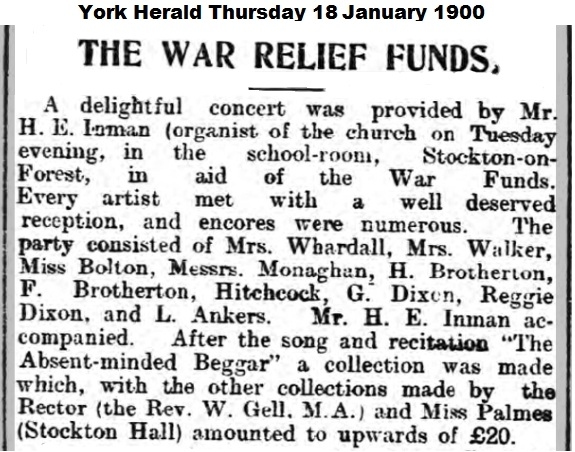
Stockton Church, then, entered the 20th century as an independent rectory with a new church. It was served by such fine priests as Rev William Gell and the biblical scholar, Rev Charles Mackie. There were able and loyal churchwardens from such families as the Beales, the Snowballs, the Sterrikers, the Marshalls and the Broadleys. The church was further enriched by gifts from parishioners, such as the frontals and covers from Miss Hunt and Miss Yeomans. The family of Canon Rawdon was also particularly generous.
When G W Lloyd eventually moved to Stockton, he became so well known for his support of the church that Archbishop William Temple attended his funeral in 1934, when he gave an address paying tribute to G W's unassuming disposition and charitable works. The esteem in which he was held by the village is seen on the wooden tablet attached to the wall of the clergy vestry.
In 1919, the entrance to the churchyard was improved by the erection of a low wall and entrance gates and nearby in 1920 a memorial in the shape of a simple dignified cross in Portland stone with a 8' high shaft on octagonal steps was erected in memory to 12 men from the village who lost their lives in 1914-18 war at a cost of £120. One name added following WWII.
In the 1920's there was an oak-wood gate and rails plus a big wooden arch/Lych-gate leading up to the Church. These had been designed by E Walker Esq. architect of York who resided for many years in the village. The footpath through the churchyard (now closed) used to lead directly to Brockfield Hall.
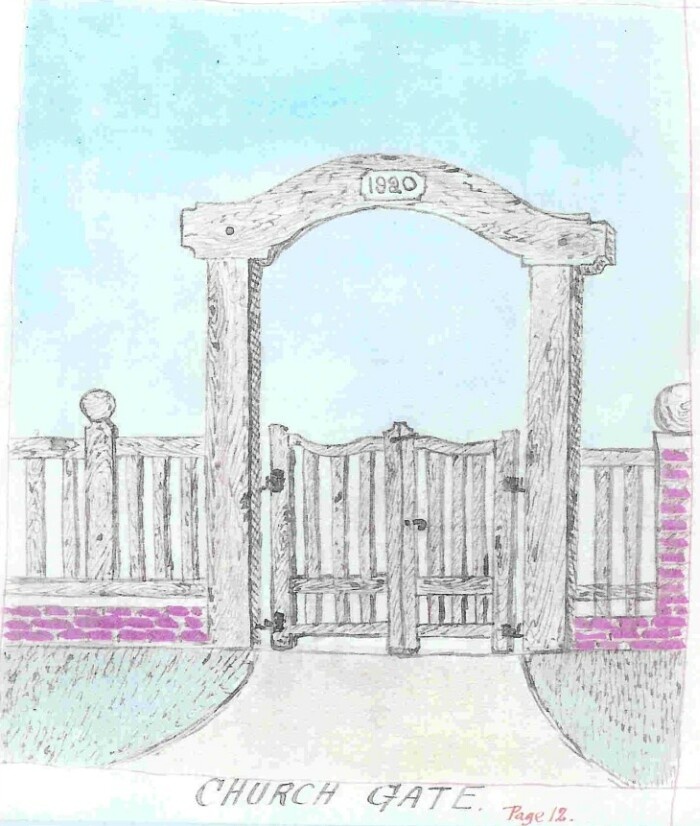 1920s drawing
In 1939, Stockton became the mother church of two other parishes when the union of the benefices of Stockton, Holtby and Warthill took place. This brought a problem of patronage which was solved in 1958 when it was decided that patronage should alternate between the Crown and the Archbishop.
The Union as declared in the London Gazette 1 August 1939 ( PDF 1 PDF2 PDF3 )
In 2005 the Vestry was converted into a disabled toilet and the Baptistry became the Vestry. A small kitchenette was built in front of the Vestry.This was made possible by grants from various bodies, the generosity of donors and a great deal of fund raising by Parishioners.
Church Plate
A plain silver chalice, one of only three pre-Reformation chalices in England, with a bell-shaped bowl and baluster stem. On the bowl is engraved upon a lozenge the Agar arms (a chevron between three boars' heads couped) and inscribed 'The gift of Mrs Margaret Agar, daughter of Thomas Agar Esq., 1735.' Height 6 1/8in, dia of bowl 3 1/2, of foot the same, depth of bowl 3 in. Hallmarks: (i) T.W. in monogram, (ii) small italic X, (iii) Leop. and lys. (Thomas Waite, York, 1654).

The paten is a silver circular plate on a central circular stem. It is inscribed 'This belongeth to Stockton Chappel 1736'. Hallmarks: (i) doubtful (ii) Brit.; (iii) li.hd.er.; (iv) Court hand O (London 1709).
A jug-shaped pewter flagon, with a flat lid, curved handle and spout. Height 12 1/2in, dia at top 4 and at bottom 6in. It has no marks and is much battered.
There are several more modern pieces.
Glass. Miss Harriet Agar and her sister Mrs Barstow presented the three-light stained glass East window as a memorial in 1895 to their aunt. At the same time, two of the three windows in the baptistery were given by the Kershaw family of Stockton House, the third by parishioners. Miss Agar and the Pearson family of Warthill Grange Farm were also to present the stained glass in the South nave. All these windows were by T F Curtis of Ward & Hughes. The Pearsons later provided the windows on the North side of the nave.
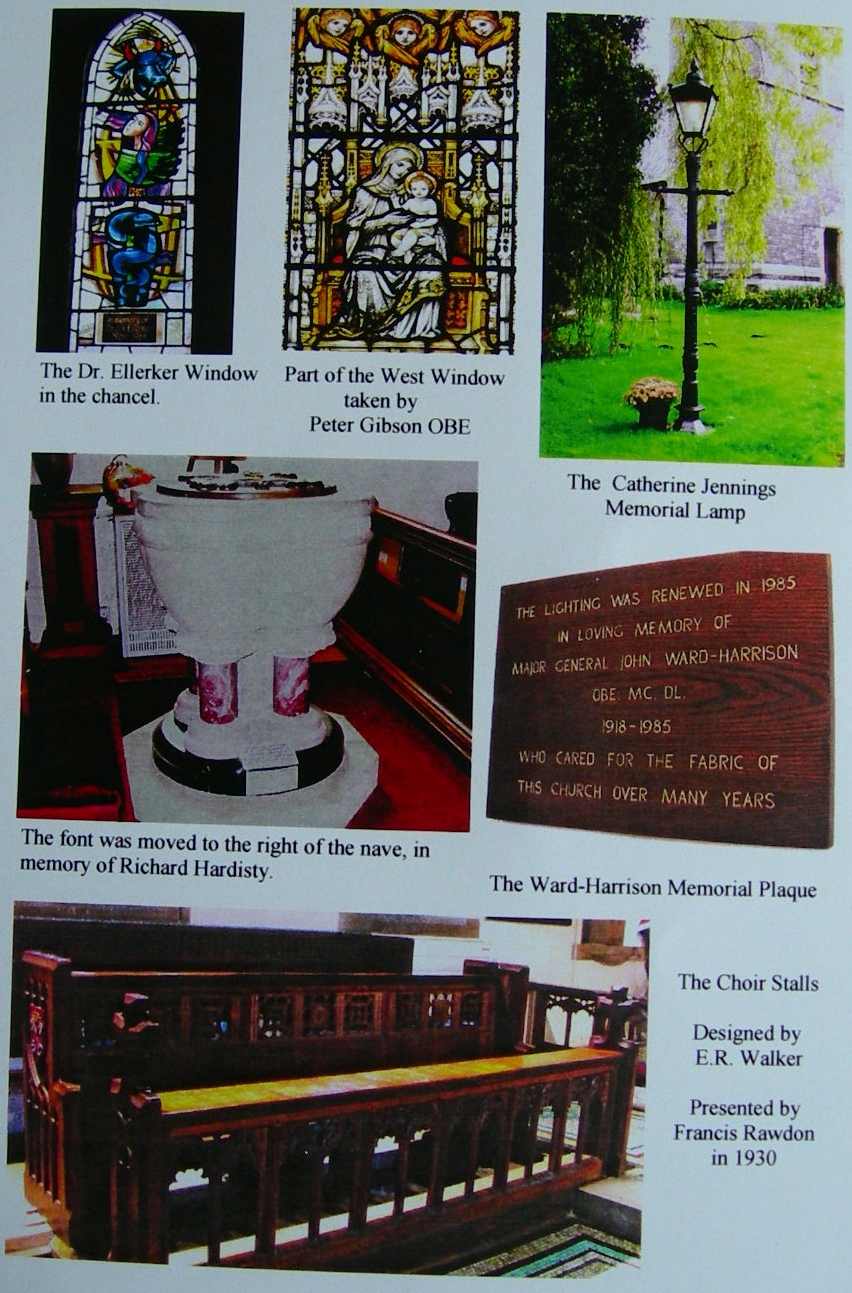
The window in the chancel is dedicated to the memory of Dr John Ellerker, a devoted local doctor, who attended the villagers from 1970 until his sudden death in 1988.
The rather fine West window was given by Frances Rawdon in 1928 in memory of her daughter Dorothea. It was the work of M Powell of London.
Chancel Screen and Reredos . Both were designed by E R Walker of York and executed in light oak by 'Mousy' Thompson of Kilburn. The screen was given by Frances Rawdon in 1923 as a thanks offering for her son and daughter, Christopher Hamer and Dorothea.
Small wooden framed plaque behind choir stalls - South Wall
To the glory of God this screen
was given as a thank offering for
the prayers of this congregation
during the Great War 1914-1918 by
FRANCES RAWDON for her son and
daughter CHRISTOPHER HAMER and
DOROTHEA and for the brave men
from this Parish.
The reredos was dedicated to James Hamer Rawdon and given by his wife and children, Easter 1918.
Brass Plate on/near Reredos
To the glory of God
and in sacred love and remem-
brance of JAMES HAMER RAWDON
Hon. Cannon of Manchester. This
Reredos is given by his wife
and children-Easter-1918.
Choir Stalls and Altar Rails. Also designed by E R Walker and given by Frances Rawdon in 1930.
"Choir stall to memory of Everilda Hamer died 1/10/1928 wife of John Hilton Molesworth, British Chaplin in Cairo 1907-1914. Daughter of Canon Rawdon, given by mother Easter 1930."
North Choir stall
In sacred memory
of EVERILDA HAMER
Oct 1 1928, wife of JOHN HILTON
MOLESWORTH
British Chaplain in
Cairo 1907-1914, daughter
of Canon RAWDON
these stalls are
given by her mother
Easter day 1930.
Organ. Built by Forster & Andrews in 1896, it was given by the Lloyds in memory of Alicia Maria Lloyd (died 19/2/1892). An electrical blower was installed in 1932,much to the delight of those who had previously had to hand pump the organ, in memory of Mabel Jane Lloyd and renewed in 1948. A complete overhaul and minor tonal modifications including the instalation of Salicet and Tremulant Stops were done in 1951, in memory of George Dixon 1864-1941 Churchwarden and schoolmaster and his wife Jane 1864-1929, by their daughter and 2 sons and a new electric blower installed 1976 by parishioners and friends. In 1999 a thorough restoration was undertaken by Geoffrey Coffin.
Brass Plate on Organ
The electric blower was given
for the glory of God
and
In Loving Memory of
MABEL JANE LLOYD
by her relations.
Brass Plate on Organ
New electric blower
installed in 1976 by
Parishioners and Friends.
Brass Plate on Organ
To the glory of God
and in affectionate memory of
A.M. LLOYD of Stockton Hall
who died 19th February 1892.
Brass Plate on Organ
In loving memory of
GEORGE DIXON 1864-1941
Churchwarden and schoolmaster
and of JANE his dear wife 1864-1929
this organ was renovated and the salicet and
tremulant stops installed in the year 1951 by their
daughter and two sons, as an act of thanksgiving
to almighty God, for their Parent’s many good works
and Godly example of life.
Processional Cross. Given by Carol Broadley in 1976 in memory of Peter Hayden.
Font presented by the Rector James Roy and his wife in memory of their children. The inscription :- "He took them in his arms, put his hands upon them and blessed them".
The font in noted in memory of James Henry Gell 12 Jun 1890 and Geoffrey Gell 18 Feb 1895.
The font was repositioned 16 Jan 2003 in memory of Richard Hardisty 16 Jul 1940 to 27 Mar 2000 as a sign of respect for the tremendous amount of work he did on the roof and church interior over the years.
17/9/1989 a silver chalice and paten were dedicated at the church service that Sunday. They were donated by Joan Gilbert in memory of her late husband, Desmond. Also dedicated were altar kneelers given by Ann Hardisty in memory of her late husband, Arthur and kneelers for the pews made by members of the congregation.
The Green Altar Frontal, Sacrament cover and Pulpit Fall were given in memory of Edward Shilleto, a retired farmer who died in 1993. He worshiped at Holy Trinity and is buried here.
Methodists
When the Methodist Church closed in 2010 a Plaque made by Ronald Young of Pear Tree Farm which had been donated to them in 1998 was moved here for display.
Monuments. The majority are to the memory of the Agar and Lloyd families, and are mostly the work of Skelton of York.
Registers before 1812 are:- baptisms & burials 1653-1785; marriages 1653-1753 ; mixed entries 1727-1782 ; marriages 1756-1808 ; baptisms & burials 1785-1808 ; baptisms 1808-1812 ; burials 1808-1812 ; marriages 1808-1812.
The Bells
Almost certainly the chapel would have had at least one bell during its history, particularly as there were many bell foundries in York before 1800. An old photograph of the church shows that about 1890 there were two bells, hung in a gable at the west end of the nave, weighing less than 56 lbs (25kg) each. Unfortunately, nothing else is known about the early bells at the moment.
In 1895, four bells were cast by John Taylor & Co, of Loughborough (just one year before that company introduced Simpson tuning). They were hung in castiron H frames with plain bearings and Hastings stays. They were given by G W Lloyd in memory of his aunt, Miss Alicia Maria Lloyd. Details are shown below (bells 3 to 6).
In the early 1960s, the bells were inspected by Taylor's and augmentation was suggested in the resulting report. No action was taken, possibly on financial grounds. About this time the Tower Captain was Michael King who, in 1983, organised a marathon ring on handbells by school children.
During the 1970s, under the direction of John Dueker, Tower Captain, maintenance work was carried out. However after 84 years of use the fittings were in need of a major overhaul. A further inspection by Taylor's the bell makers who have made regular inspections of their bells over the years was arranged in 1979, and their report recommended a major overhaul of the fitting was required, they also recommended augmentation by two new trebles.
This could not be considered on financial grounds. But stage one of the repairs was carried out the same year, work in the tower and transportation being undertaken by Alan Hearn, the new Tower Captain.
Early in 1980, a proposal from David Potter, Ringing Master at York Minster, on behalf of the York branch of the Yorkshire Association of Change Ringers was accepted by the P.C.C. The branch would buy the two new trebles and the P.C.C. would pay for the overhaul which consisted of partial dismantle of the existing ring and then a rebuild to accommodate bells on the bottom tier.fittings and frames. Much to the surprise of the P.C.C. the bells were cast and paid for by the end of that year. So the local band and York ringers started fundraising for the fittings and frames, mainly in the city.
In late August 1981, under the direction of David Potter, ringers from York towers partly dismantled the existing ring and then rebuilt it to accommodate bells on the bottom tier. New girders were installed to support one bell, the former second. The whole frame was repainted and new gudgeons fitted by a York firm. The old four were rehung on ball bearings.
The rehang was delayed by a serious accident when a ringer was thrown into the air by the third bell of the six and then the first time all the bells were rung together it was discovered that, despite careful calculations, the first and sixth clappers touched. A rehang was quickly arranged so that the bells could be rung at a service the following day.
| Bell | Weight | Inscription | Cast |
| Treble | 2cwt lqtr (114kg) | 1980 | |
| Second | 2cwt lqtr (114kg) | 1980 | |
| Third | 2cwt lqtr (114kg) | We Praise Thee | 1895 |
| Fourth | 3cwt lqtr (165kg) | We Bless Thee | 1895 |
| Fifth | 4cwt lqtr (216kg) | We Give Thanks to Thee | 1895 |
| Sixth | 5cwt 3qtr (292kg) | O Lord God Almighty | 1895 |
Number of Bells: 6 ; Tenor Weight: 5-1-5 ; Key: D (is this key of the tenor or the peel)
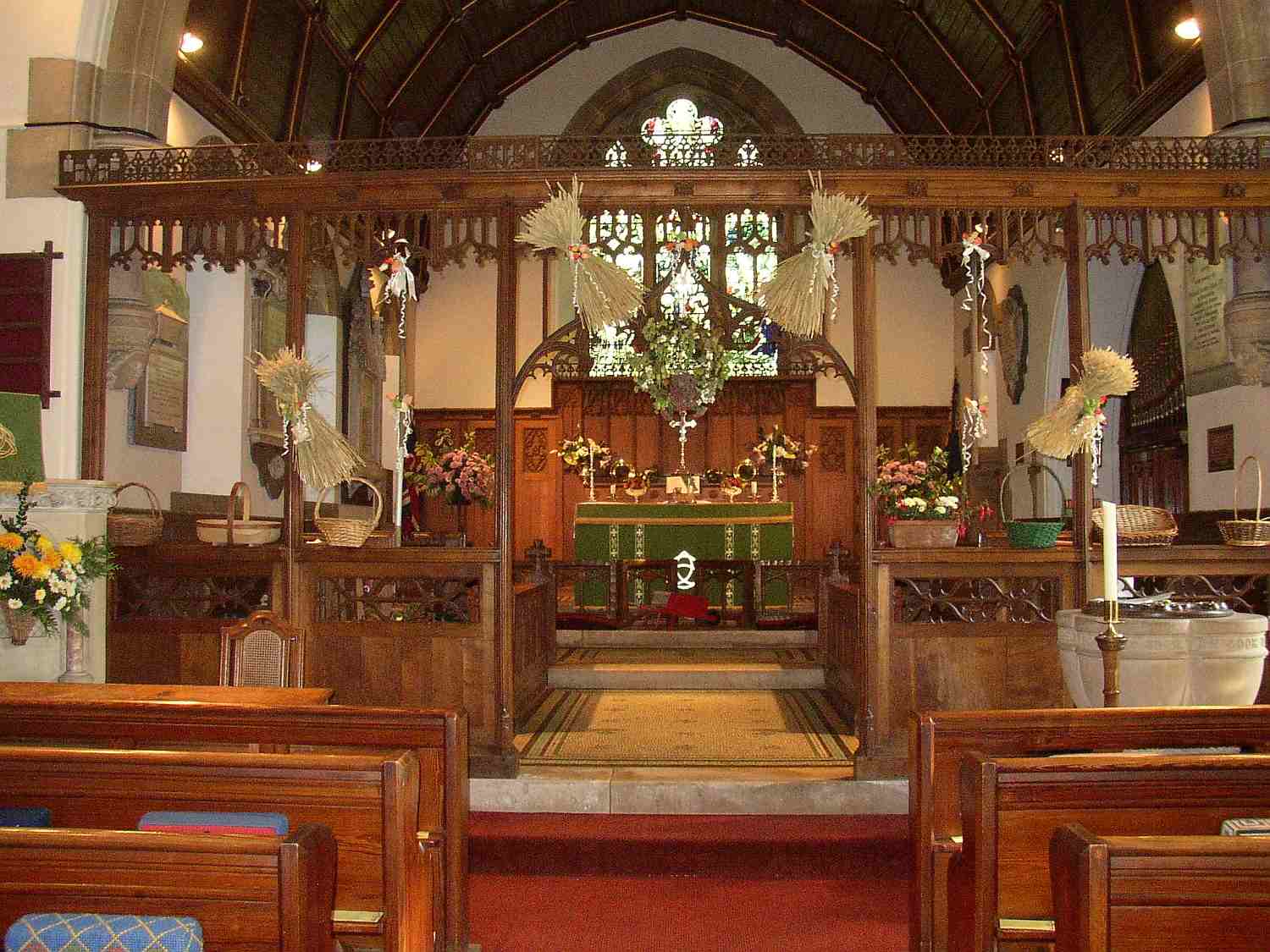
Harvest Festival - photo by Hilary J Seavers
Church Customs 1940/50s
Coming up towards Christmas we all used to get together and go out 'Carol Singing' in the village round Stockton, Warthill and Hopgrove, Bill Midgley he played the violin, and we used to tramp around, one place we used to go when we went towards York was Beattie Barkers Farm where we always finished up at, because when you arrived you used to have to sing the Carols outside and when you had finished, Beattie used to come and open the door and in you went, where there was a big farmhouse table and your name it, it was on there to eat, and so it was Christmas and as she had no family, you were always there an hour or so just talking etc, making a night of it for her, as she only had her husband Arthur who was a Semi- Invalid, and her nephew who ran the farm for them.
One of the ways of gaining a little more spending money around this time was the traditional tying together of the church gates - this meant that the groom had to throw money to disperse the village children, thus allowing him to cut the string and emerge with his bride.