Grace Darling
Grace Horsley Darling was born on 24 November 1815, ‘the year of the Battle of Waterloo’ as she was often reminded. She was born in her grandparent’s small cottage opposite St Aidan’s Church in Bamburgh and was the seventh of nine children. The cottage still stands.
Her Grandfather, Robert Darling, had been keeper of the Brownsman Lighthouse since 1795. Shortly before her birth her Grandfather died and her father William became the new keeper at Brownman.
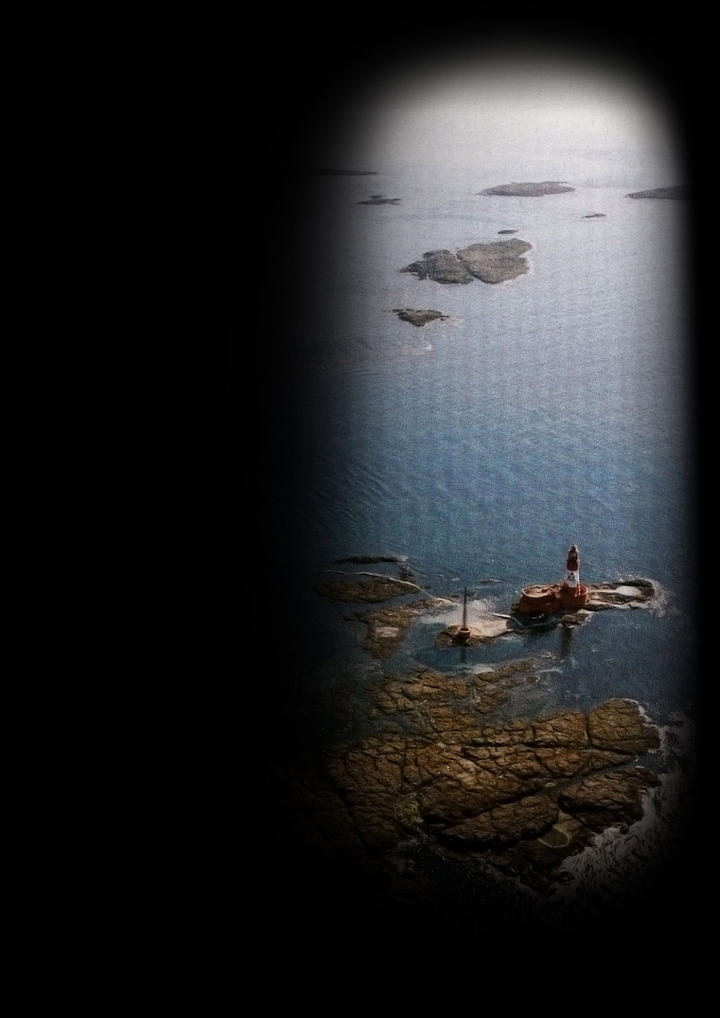
In January 1826 the Darling family move to the Longstone Lighthouse, which had been built to replace the old Brownman one, but they were allowed keep the land for livestock and a garden as the Longstone was built on barren rock.
The family in 1826 was:-
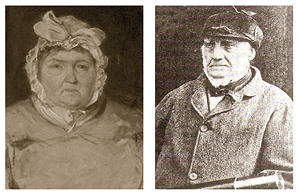
William Darling , Keeper of the light, Father, at 40 years old, a fit and healthy man in the prime of his life. A keen naturalist, he kept records of bird counts and corresponded with ornithologists and with museums.
Thomasin Darling, nee Horsley, his wife, was 52 and had successfully raised nine children, including two sets of twins. In later years she seldom left the island.
William, the eldest son, (called Laddie to distinguish him from his father) was now 20, having left the islands at 16 to become a joiner.
The twins, Mary Ann and Thomasin, (the latter know as Sister to distinguish her from her mother), were almost 18 years old.
Mary Ann moved to the Main, to Bamburgh to become a dressmaker in the summer of 1829. She was to marry three years later.
Thomasin, Sister, was born with a hare lip, of which she was self-conscious. She stated from an early age that she would never attract a man nor marry because of it, and she never did. She moved to Bamburgh with Mary Ann as her housekeeper. She outlived her by many years.
Job, at 15, moved to Newcastle to find work as a joiner like his eldest brother. Sadly he died of a fever before his 20th birthday.
Elizabeth Grace, known as Bessy was 13. She left the island later, to marry a draper. She died at the early age of 32.
Robert, at the time of the move, was 12. He was schooled at Bamburgh Castle, coming home just for weekends. At 15, like the others, he moved to the Main. He became a stone mason, living at Belford.
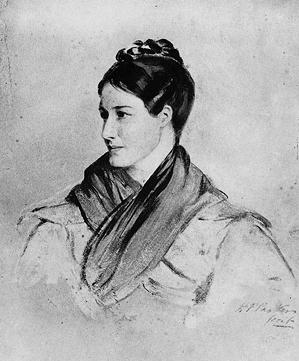
Grace Horsley, 11 years old, was the youngest daughter; she did not attend school but was taught at home by her father to a high standard. Despite dramatic events she was to remain at Longstone for the rest of her short life.
George Alexander and William Brooks were the youngest Darlings, and the second set of twins born to William and Thomasin. They were just six years old at the time of the move and, like Grace, lived many years on Longstone.
Grace in her teens.
Aged 17, Grace and her thirteen
year old twin brothers George Alexander and William Brooks were the last
remaining children at home with their parents. Grace became William's
virtual assistant, helping with his duties, maintaining the lantern,
taking her turn with the watch from the lantern, mending fishing nets etc.
If he was busy she would row the two miles to Brownsman on her own to see
to the garden and the animals.
Grace was dutiful and, as the youngest
girl still at home, would have been expected to look after her parents in
their old age. For this reason she was reluctant to leave Longstone for
other work, or indeed to seek a husband. She was happy with her lot and
William was glad of her help and of her company. The two became very
close. She would look out for ships or for hazards, well trained by her
father. Their livelihood depended on it. Grace was a good watcher. She
could observe things intently: the signs and patterns of the sea, the
clouds, any movement on the rocks. Her knowledge of the tides, of birds,
of fish would all help in forecasting signs of potential problems. Her
patience, sometimes watching for hours with a telescope, helped develop
special skills in observation. William and Grace could work together,
almost of one mind.
The Rescue
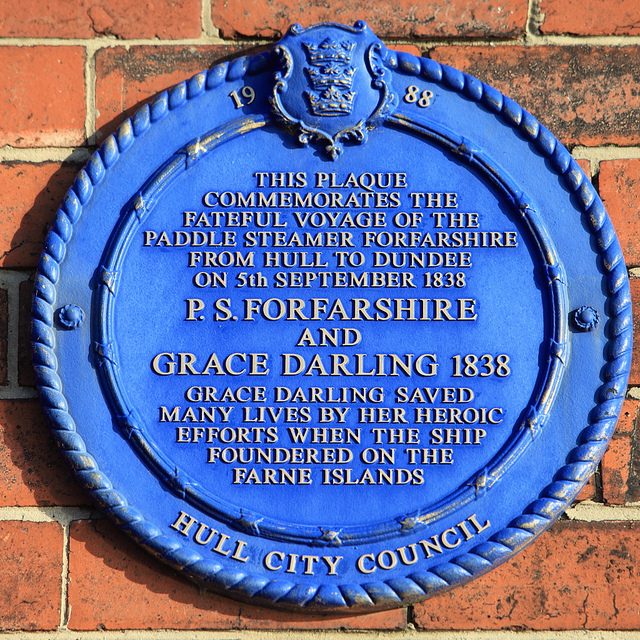
On the day the steam ship Forfarshire left Hull on 6 September 1838, only Grace and her brother William Brooks lived with their parents on Longstone; all the others had left.
William Brooks was away fishing at Seahouses when the shipwreck occurred. This meant that only Grace and her parents were in the lighthouse, at the mercy of a dreadful storm.
In the early hours William woke Grace to help him tie up everything including the coble, their large wooden open fishing boat, the weather was so severe. The tide was high and the sea was nearly up at the boathouse. They secured everything they could and went back to bed.
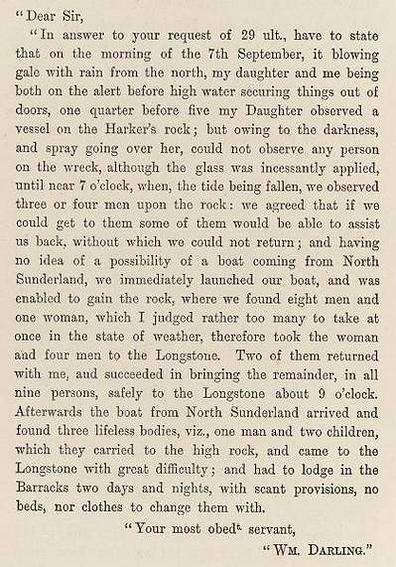
Her sleep disturbed, Grace, through her third storey window, was watching the storm and saw a large black shape on Big Harcar Rock. It was a wreck! Grace woke her father and with a telescope they studied the wreck for signs of life. They saw none. Grace watched and watched. As daylight crept in around 7.00am Grace saw movement on the rock. There were indeed survivors of the wreck; two or three perhaps. William thought the sea too rough for the Seahouses boat to set out, or, if it did, that it might not reach the rock. So he pondered. He knew the rocks and he knew the tides. Grace pleaded with her father that they both take out the coble to rescue them. Thomasin feared they would both be lost but Grace was already down at the coble, William knew he could not go out alone, so at the right moment they pushed the twenty-foot boat out into the sea. Thomasin watched, with dread from the lantern. At first she couldn't see the coble and feared the worst.
William had decided a southerly course to Big Harcar would see them benefit from some little shelter or else the coble would be at the mercy of the storm. This meant going the long way round. The route they took from Sunderland Hole on Longstone took them through the passage called Crafords Gut, down to Blue Caps then towards Harker. Nearly a mile in distance. Defying the wind, the swell of the sea, the spray, the noise and the physical effort involved they eventually made towards the wreck and could see on the rock more survivors than they expected - nine or ten. William realised immediately that two trips were now required.
William and Grace managed to manoeuvre the coble near enough to the rock to enable William to leap across to the survivors. Grace now had to steady the coble on her own for some time, until her father could gather the weak survivors and attempt to transfer them into the boat. He would have had to be strong-willed in deciding who to take back and who to leave on the rock. There would have been distress, arguments, shouting over the noise of the storm. Mrs Dawson had her two small children clutched to her breast. They were dead and had to be left behind, for now. The extent of her anguish can only be imagined as, at William's insistence, she had to leave her children, lifeless, on the rock and be helped down to the coble.
An injured man was next; but William needed strong men to help, so he took two of the crew members, John Tulloch and John Nicholson. This left Daniel Donovan and three others on the rock, plus the bodies of Reverend Robb and Mrs Dawson's children.
The crew members would have helped with the oars; Grace would have helped comfort the grieving mother and reassure the injured man as best she could. What a mixture of emotions William and Grace must have experienced. Exhausted, having hardly slept that night; joyous that lives had been saved; sorrow for the mother's loss; fear of the dangers of a necessary return trip in the storm.
They arrived safely at Longstone and William
returned with the two crewmen to collect the remaining survivors. The
three bodies were left, to collect when it was safer to do so. The whole
rescue took two hours, from 7.00am to 9.00am.
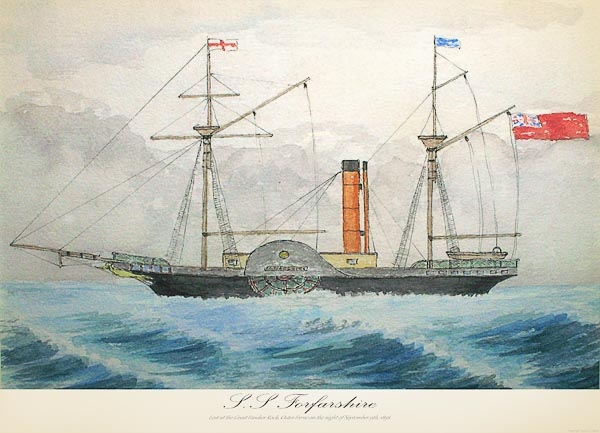
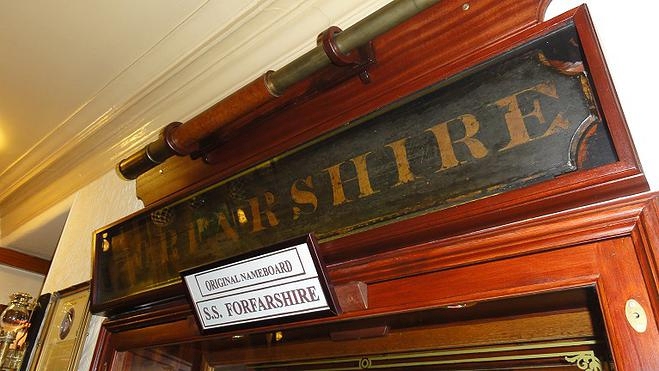
S.S. Forfarshire
The Forfarshire, a paddlesteamer with brigantine rigging built in Dundee in 1834, was commissioned by the Dundee & Hull Shipping Company to travel between Hull and Dundee on the east coast of Great Britain. Costing some £20,000, she weighed 400 tons, was powered by two 90 horsepower steam engines, and had the capability of being powered by sails. She could accommodate passengers, horses, carriages and livestock as well as cargo. There were state rooms with fine furniture, marble mantelpieces, gold-framed mirrors and gilt-scrolled china, illustrated with images of the ship itself. Cabin-class passengers enjoyed the quality fixtures below deck, whereas the Steerage passengers had basic accommodation.
The Forfarshire set out from Hull, sailing north, on the 5/6 September 1838, with some sixty people and cargo including cloth, soap, hardware, boiler-plates etc. on board. She had her boilers inspected while docked in Hull and mechanics had made a small repair. Several passengers had never been to sea before and became a little unsettled by this. Passing Flamborough Head a failure of pumps supplying water to the boilers reduced her steaming capacity. Her situation deteriorated through the next day as leaks from her boilers flooded the bilges, and at 10pm that night, off St Abb's Head, her engines failed. The decision was made to empty the boiler and repair the leak, rather than putting in to shore. In such circumstances, emptying the boiler was not uncommon but it was a noisy process and could not be disguised which could have worried the passengers even more. Despite near gale force North-easterly winds, her captain put her under sail and continued on his way; but the weather worsened to a full gale, with heavy rain and a change in wind direction to due North.
At 2.00pm the Forfarshire had passed the Tyne. The captain assured all passengers that the boiler noise had been a slight adjustment only and there was nothing to be concerned about. By 6.00pm the ship was turned around to run before the wind and seek shelter behind the Farne Islands, by passing between land and the Inner Farne in what is known as the Fairway.
However, by 11.00pm passing Berwick and the Tweed, the weather changed very quickly to a full gale, with heavy rain and a change in wind direction to due North battering the Forfarshire. The extra pressure exerted on the boilers to make headway caused another leak. It was not possible to get sufficient steam to progress and the captain had to stop the engines and decided to turn back. In strong winds and with a makeshift sail Captain Humble proposed making it back to the Farne Islands. But the storm increased. The dark night, the high seas and the lashing rain made it increasingly difficult to steer, or even to see. Also, in these conditions the redundant paddles were a hindrance.
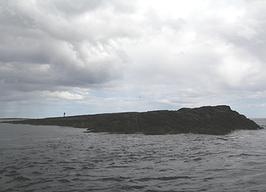
Captain Humble could make out a light, – the light of the Inner Farne. It was 4.00am on the 7 September and he hoped to find a little shelter and anchor there until the storm passed. He steered to the right of the light, the land-side, the Fairway, the way they had come, but he had miscalculated. The light he had seen had been that of Longstone, and the land-side of that contained many dangerous rocks – and the Forfarshire struck them. It hit the Big Harcar Rock, about one mile from the Longstone Light.
A group of eight sailors and one passenger, Ruthven Ritchie, managed to lower and escape in a lifeboat. The swell of the wild sea swept them away from the wreck and into the open sea to be picked up the following morning by a passing schooner. The Forfarshire lurched and struck the rock again, splitting the vessel in two. The front bow and fore sections of the ship anchored to the rock; the stern quarterdeck, with the paddles and all below deck was lost to the sea. The passengers would have drowned in their cabins. The only survivors at this stage were the ones on deck. The storm continued but the tide was falling, exposing more rock, causing the battered remains of the ship to become even more unstable.
At this point John Tulloch, the ships carpenter, and Daniel Donovan an itinerant Irish labourer decided to jump onto the rock itself and encouraged the few survivors to join them. Anxiously, they helped each other onto the rock. They then approached Reverend Robb, crouched in the engine room, hands clasped in a final act of prayer. He was dead. From his position he appeared to have resigned himself to his fate. They decided to save his body from the sea and dragged him onto the rock.
The survivors on Big Harcar Rock were:
Thomas Buchanan, baker from
Dundee
Sarah Dawson, bound for Dundee. Her two children died in her
arms
Daniel Donovan, Irishman, claimed he was a fireman to gain free
passage from Hull
James Kellie, weaver from Dundee
John Kidd,
crewman: fireman from Dundee
John McQueen, crewman: coal-trimmer from
Dundee
John Nicholson, crewman: fireman from Dundee
Jonathan
Tickett, crewman: cook from Hull
John Tulloch, crewman: carpenter from
Dundee
 |
 |
 |
 |
 |
 |
 |
 |
 |
 |