Coaching Days
Coaching's effect on Stockton
Anecdotal
evidence says that Lord Martin Fitz-Allen-Howard of Brockfield Hall once had a
book with quite a bit about the Fox Inn at Stockton, in which it said that in
1640 there used to be a change of horses for the London Stage Coach at the pub.
Anecdotal evidence against this is that:-
1. The village is not on the York-London
route.
2. Coaching didn't really start until the mid 18th century when improvements
to roads began to be made.
3. The first stage on the later Leeds to Scarborough
coaches was Tadcaster after 15 miles; 10 miles
was a common distance between horse changes; Stockton being only 6 miles from York, suggests
it wouldn't even have been a stage for the Scarborough coach;
4. Would you
stable horses 6 miles out from where they were needed when there was plenty of
stabling in York itself?
(Stockton isn't on the route but could there have
a horse dealer/breeder/stables here with suitable horses for a stagecoach?).
The Days of Stage Coach Travel
The first coach of any description seen in England was in the year 1555, when the Earl of Rutland had a State carriage built for him by one Walter Rippon, but the progress of locomotion was so slow, and met with such a vast amount of opposition, that it was almost a century later before the advent of any public stage coach.
Stagecoaches did not commence to run until 1640, but their advent was not marked by any particular rapidity of progress, as more than twenty years later there were only six stages running in the whole of England.
The earliest mention to be found of stages running through Yorkshire dates from about eighteen years after their first introduction into England, in the form of an old advertisement:-
"From
the 26 April, 1658 there will continue to go Stage Coaches from the George Inn
without Aldersgate London into the several Cities and Towns for the rates and
at the times hereafter mentioned and declared
Every Monday Wednesday and Friday.
To Salisbury in two days for XX.s. and Exeter in four days for XI. s.
To York
in four days for XI. s.
Once every fortnight to Edinburgh for IV.l. apeece."
The roads at this time throughout the entire country were in a frightful condition, which was probably the principal cause of the slow progress of stage coaching.
After the first Act of Parliament was passed in 1662 for making turnpike roads, and the roads began to improve additional coaches began running between London, York, Chester, and Exeter, each having forty horses on the road. Roads however were still bad, according to Sir Walter Calverley's diary in 1694, it took about four days to go from Doncaster to London, and the state of perfection to which coaching was brought, when in the height of its glory, will be seen from the fact that in 1815 the Leeds Union did the distance between London and Doncaster (one hundred and sixty-two miles) in sixteen-and-a-half hours, which included two hours for stoppages.
As early as 1678 there was a coach running between York and Hull in the summer time mentioned by Ralph Thoresby, the historian, in his diary, on his arrival from Holland, as follows: "Nov. 1678. From Hull we came by coach to York, and thence on horseback to Leeds. The stage coach being over for winter...."
In 1683 there was a London coach running from York, through Tadcaster, Ferrybridge, and Doncaster. Leeds passengers were obliged to ride on horseback to either York or Ferrybridge to join the coach. After this coach was established it continued to run regularly.
There are references to a service from York to London started on 18 April 1703 and another on 12 April 1706 from the Black Swan but its not know whether these were in competition, a new provider or if there had been a break in the service due to winter. At this time coaches were drawn by four horses with seating for 4-6 people inside and up to 12 outside. Stages were at about 10 miles intervals to change the horses. The fare was about 1/- for every 5 miles with 40-50 traveeld in a day.
In 1754 there was introduced a coach
with springs, which was described as a two-end glass coach machine, exceedingly light and
easy, to go from Edinburgh to London in ten days in summer and twelve
in winter. And now the roads commenced to improve due to the new turnpike roads, and
the speed of coaches began to be greatly accelerated. In 1768 a new coach called
"The Fly " commenced running between Leeds and London, and actually
performed the whole journey in two-and-a-half days; and a year later there was
yet another coach started, doing the same distance in the same time: whilst in
1775 there was no less than four hundred coaches on the road in different parts
of the country. But in the following year (1776) a very great improvement on the
old time seems to have been made, as we find a coach running from the Old King's
Arms, Leeds, to London, in thirty-nine hours. Sheffield and other towns followed,
the average speed being about eight miles an hour.
In 1780 the velocity
attained by stage coaches far exceeded that of the mail which was carried by post
horses and mail Carts. Mr. John Palmer, perfected a plan to carry mail on coaches
and despite great opposition commenced those parliamentary exertions which
ultimately transferred the mails to the coaches in 1786, which year marked the
commencement of the real glory of the road. On July 24th, 1785, the first Royal Mail ran
from London to Yorkshire, through Sheffield, Barnsley, and Wakefield, to Leeds.
On the 16th October, 1786, the first mail coach from London, by the Great North
Road, set forth on its journey.
From the latter part of the 18th century and the beginning of this, coaching made rapid strides, and when at its height, about 1835, there were no less than seven hundred mail coaches running in Great Britain and Ireland, whilst the stagecoaches had increased in equal proportion. By a superior and more durable system of road making, brought into vogue by Mr. McAdam, the speed of the mails was greatly increased, the best coaches doing their regular average of ten miles an hour; indeed, in 1836, the London and Edinburgh Mail did the whole distance of four hundred miles in forty-five-and-a half hours, which included all stoppages. These being deducted left the average time at close on ten miles an hour, and this coach did the one hundred and ninety-seven miles from York to London in twenty hours, which time included stoppages.
At
the beginning of the 19th century there would be close on forty coaches running
in and out of Leeds daily. Fifteen or sixteen years later this number had increased
to double that amount; and by 1825 there were upwards of one hundred and ten coaches.
1838 was probably the busiest year of the coaching era with the grand total of
coaches arriving and taking their departure from Leeds up to one hundred and thirty.
In
their heyday during the Scarborough and Harrogate seasons the daily arrivals and
departures from the two York inns would be considerably augmented by the arrival
of duplicate coaches to something like sixty in number, which would greatly test
the resources of the vast stabling lying between the two establishments.
After the railways opened enterprising coach proprietors made efforts to cope, changing their routes and running over new ground when it was found that steam was gradually encroaching on their occupation. The last to leave the road were the season coaches to the watering places. Some of those to Harrogate, Ilkley, and Scarborough, were running long after the railways had obtained a firm and decided footing.
Coaches
The following are known services that will have passed through the Parish.
diligences
The
period term for the stagecoach was diligence. The early services referred to them
simply as the 'Town' diligence and so over a period of time similar named coaches
could in fact have be different operations.
Two such concerns were the Leeds,
York, and Scarborough diligence partly worked from the Star and Garter Inn, Leeds
towards the end of the 1700s; and a pair-horse diligence, driven by old Tommy
Raper, every Tuesday, Thursday, and Saturday, for Malton and Scarborough from
the Old Sandhill Inn, Colliergate, York (undated but could be as late as 1828);
Pigott's Directory for 1816/7 notes a Scarborough Diligence running the much
shorter route from the White Horse, Coppergate, York at half past seven in the
morning on Monday, Wednesday and Saturday for Malton. They also list True Blue
and Old True Blue as separate concerns yet other evidence suggests that the originally
named Scarborough Diligence used both these names during its existence.
Leeds and Scarborough Stage Coach (1754-1770)
The first evidence of a possible coach service through Stockton is for 1754, just after the passing of the York to Scarborough Turnpike Act 1752. A regular coach service ran to Mr. Cais' Talbot Inn, Scarborough every Wednesday, from Thomas Spink's, painter and undertaker, Kirkgate, Leeds. The coach returned from Scarborough every Friday morning. Each passenger was allowed ten pounds of luggage, and all above that weight was charged at the rate of ten pence per stone. It was called the Leeds and Scarborough Stage Coach, but it was better described as a four-wheel post-chaise. The White Horse, Coppergate, York was its stop in the city and they provided fresh horses. It continued to run from Mr. Spink's until 1760, when its starting place moved to Mr. Joseph Child's, at the sign of the Post Chaise, Briggate, on the same days, still to the Talbot, Scarborough. The journey occupied two days, the passengers sleeping at Malton on the first night and the fare being eighteen shillings. This coach continued to run up till 1770.
York and Scarborough Diligence/True Blue/Old True Blue 1781-1845
The
next known named service was the York and Scarborough Diligence, which ran from,
Leeds via York to Scarborough. The service ran from 1781 until 1845.
This
coach was first worked from the Talbot Inn in Leeds kept by Mr. Christopher Topham
who horsed both the Scarborough and Hull diligences.
They left at six each
morning, through Tadcaster and York, to Mr. Stephens', the New Inn, Scarborough.
Fares: Leeds to York, five shillings; York to Hull, seven shillings and sixpence;
York to Scarborough, eight shillings. These two coaches shortly afterwards amalgamated,
and were transferred to the Golden Lion from July 5th, 1781, where it was conjointly
worked by Mr. Vincent of the Golden Lion and Mr. William Wood of the Old King's
Arms in Briggate. In a year or two it went over to the Golden Lion entirely. The
fare to York from Leeds now being six shillings.
For the first twenty years
of its existence it underwent numerous changes at the York and Scarborough houses,
but kept steadily on at the Golden Lion. Ultimately the Black Swan, York, and
the Bell and Bull, Scarborough, became the permanent houses from which this coach
was worked. In winter time it ran to York only, and there was but little alteration
in its working save that, as it made better time, it started at the more convenient
hour of nine.
The White Horse and the Golden Lion coaches were thrown together
in 1840, and it ran from both these houses and the Bull and Mouth in Leeds, as
did most of the coaches that still remained on the road at that time.
When
it became fashionable to give coaches names, this concern devolved into the True
Blue becoming one of the best known and most popular on the road. It was one of
the oldest coaches on the road, and was still running as late as 1845 as the Scarborough
Old True Blue.
Baines's Yorkshire for 1823 states the Diligence ran to New Malton from the Red Lion Inn, Monkgate every Mon., Wed. and Sat. morning at 1/2 past 7 o'clock and returned at 6 in the evening.
True
Blue
Pigott's Directory for 1816/17 is confusing because not only does
it list a Scarborough Diligence (see above) for this year but it also lists:-
True
Blue left at ten every morning from the White Swan, Pavement York for Scarborough,
during the summer.
Old True Blue left at ten every morning from the General
Coach Office, Coney Street; York for Scarborough, during Summer.
Old
True Blue
This was a Leeds to Scarborough coach.
Baines's
Yorkshire for 1823 states the Old True Blue ran to Scarborough every day (except
Sunday) at 12 at noon from the Black Swan, Coney Street taking 7 hours. It says
True Blue returned from Scarborough at 30 minutes past noon (assumed to be the
same service and that they had at least 2 coaches)
According to Pigot &
Co's directory of Yorkshire 1828-29, the Old True Blue, from Hull and Scarborough,
called at the Black Swan, every afternoon at three, on its way to Leeds and every
afternoon during the season at one on the journey from Leeds to Scarborough.
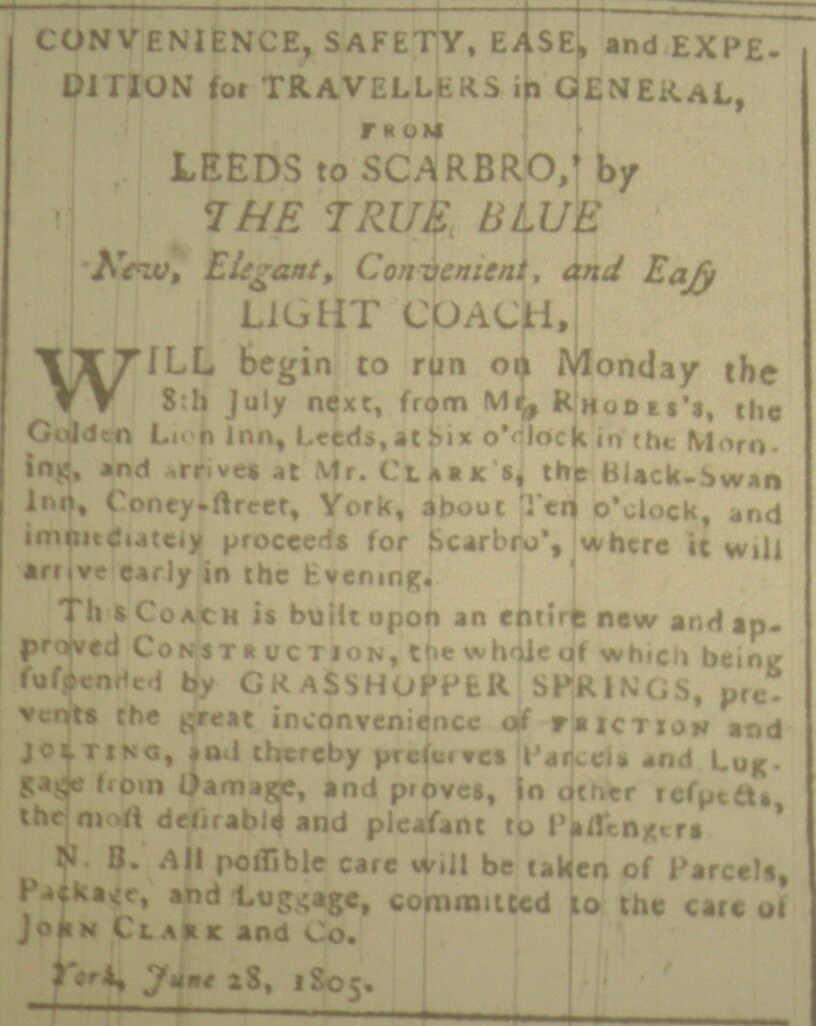
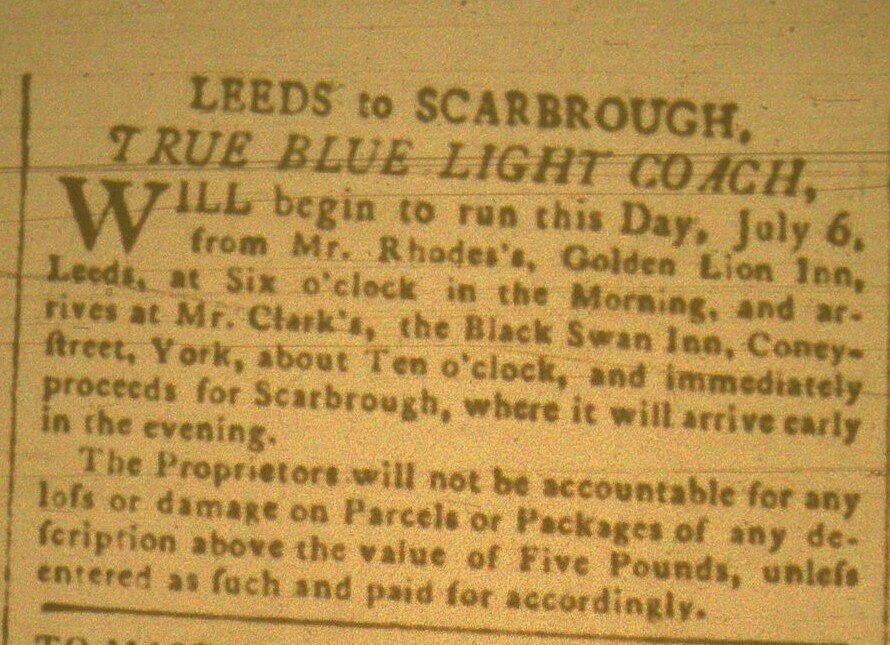
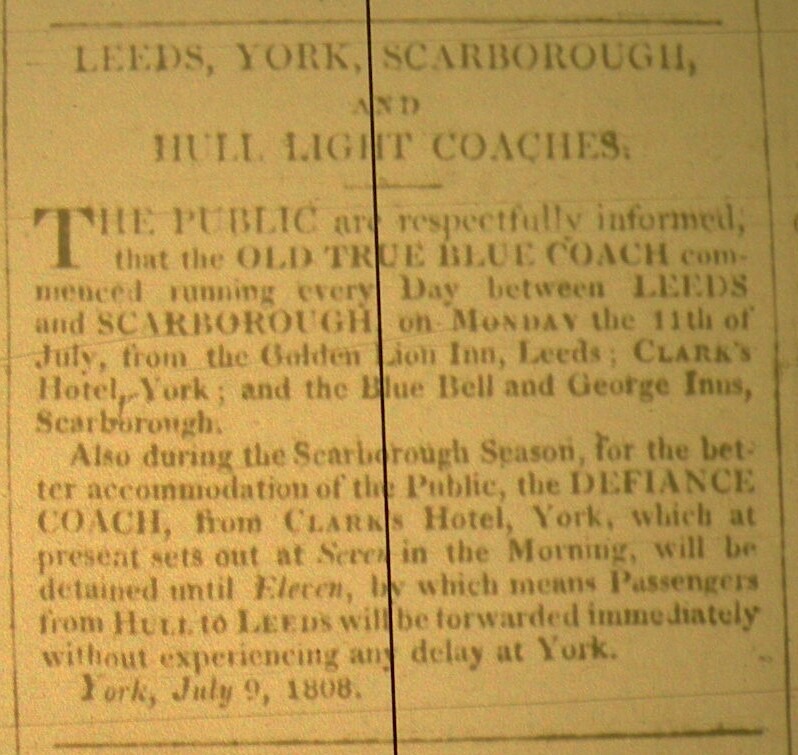
Newspaper notices advertising the start of the summer coach runs to Scarborough in 1805, 1807 and 1808.
Ebor
(1825?-44?)
A daily service between Scarborough, York, Wakefield, Sheffield,
and Birmingham which left the Tavern and Black Swan, York on alternate days, at
noon, for Birmingham and according to Pigot & Co's directory of Yorkshire
1828-29 during the season, at half past ten from the York Tavern every morning
to Scarborough via Malton, Yeddingham, Snainton and Wykeham.
Eclipse
1787-92
The Eclipse ran between Leeds, Sheffield and Birmingham began from
the Star and Garter in May 1789, but on the 9th of May 1791, it was removed to
the Hotel, until February in the following year, when it was removed to the Golden
Lion. It ceased to run to Birmingham in June 1792, but was put upon the road as
a Leeds and Scarborough coach, running from the Old White Horse Inn, Boar Lane,
Leeds and the Hotel on alternate days.
Hope
1792
Ran from the Old King's Arms, Leeds, daily, at 6 a.m to arrived at
the George Hotel , in Coney Street, York, at 10-30 a.m to connect with the Scarborough
and Hull coaches. It returned from York at 4 p.m. Performed by Hick, Dawson, &
Co.
Royal Umpire 1823-4
Ran
between Leeds, York, and Malton from the Bull and
Mouth, Leeds, at 10-30 a.m.,
daily; returned via the White Swan and T. Waite's Commercial Hotel, Castlegate,
York, at 4 p.m. and was horsed here by Mathew Outhwaite, T. Raper, and J. Robson.
Royal
Union Coach,
The Royal Umpire left The Commercial Inn, York for Leeds
every afternoon at four, and another Royal Umpire left at the same time every
Tuesday, Thursday, and Saturday for Malton and Scarborough. These coaches were
horsed by Isaac Robson and old Tommy Raper who stabled their horses at The Old
Sandhill Inn, Colliergate, York, which was kept at the time by Mrs. Monkman. One
source suggests that the Scarborough coach was a pair-horse diligence, driven
by old Tommy, and another that there were two coaches to Scarborough but as they
ran the same 3 days this seems unlikely unless it was a busy route that didn't
warrant a second full size coach.
Afterwards it removed to the White Swan
when Mr. Woodhead kept it, although it now left daily for both places. Another
Royal Union post coach, ran from this house to Mr. Lewis's, Humber Tavern, Hull
Later
the service moved to the White Horse in York where the first coach may have gone
to Sheffield rather than Leeds. The Scarborough coach ran at two in the afternoon,
and Mr. Charles Palmer who had his coach office in the White Horse yard, where
he stood his horses, horsed it, in conjunction with Mr. Braithwaite, on the first
stage to Scarborough. (thinking of the Brockfield book could the parents of the
Braithwaite at the Fox been this person?)
Union 1828-35
Ran between Leeds and York. Left York each morning and returned from the Golden Lion, Leeds, at 7 p.m. Performed by William Lee & Son. In 1834 it ran from the Union Inn, Briggate, at 10 a.m., daily, via Thorparch to the White Horse, Coppergate, York, where it arrived 1 p.m.; returned 2-30 p.m.; arrived Leeds, 6 p.m. In the season, it ran forward through Malton, to the Blacksmith's Arms, Scarborough.
True
Briton 1812-1845
The True Briton, running between Hull and Manchester started
in 1812, and left the Bull and Sun, Mytongate, Hull, at six each morning, running
to the White Swan and King's Arms, York, thence to the Bull and Mouth, Leeds,
where the passengers dined. It left Leeds at three via Huddersfield to the Palace
and Swan Inns, Manchester, where it arrived about ten at night. In November of
the same year it devolved into two co-operation coaches, the Manchester coach
leaving Leeds at nine each morning and the Hull coach at eight. The Manchester
True Briton with minor changes remained on the road to the end of the coaching
days, in its latter days was horsed from the White Horse. The Leeds and Hull section
of this coach in 1814 began to run between Leeds and Scarborough, and became the
permanent Scarborough
True Briton, also running to the end of the coaching
days. It left the Bull and Mouth at six each morning, running by Tadcaster, York,
and Malton, and thus it continued with but little change.
True Briton change
horses at the Rose and Crown, Tadcaster, a fifteen-mile stage from Leeds.
The
Prince Blucher 1817-39
This Leeds to Scarborough coach was put upon the
road on July 14th 1817, and in its early days was variously worked from the Golden
Lion, the Hotel, and the Rose and Crown, until 1824, when the first-named inn
became its final home until it went off the road well into the thirties. The following
rather tasty advertisement applies to this coach:-
"1824. More War. -Various
reports having been industriously circulated throughout the country stating that
the Prince Blucher was going to be united with his opponents between Sheffield,
Leeds, and York, the proprietors of the Blucher Coach take leave to apprise their
friends, and the John Bull in particular, that no union has taken place, and that
the Prince is still alive, and will be supported as heretofore, and that every
accommodation will continue to be afforded to the patrons of his Royal Highness,
not doubting that under the protection of such a warrior the public will be gratified,
and, at the same time, the original promoters of the coach ultimately benefited."
The
Prince Blucher changed horses at the Rose and Crown, Tadcaster, a fifteen-mile
stage from Leeds.
Pigot & Co's directory of Yorkshire 1828-29 suggests
that the coach was still running from the Hotel & Rose & Crown Inns at
that time. Departure was every morning at ten, during the summer season, going
through Tadcaster, York and Malton. It called at the York Tavern every afternoon,
during summer, at half past one on the reverse journey from Scarborough.
Baines's
Yorkshire for 1823 states the Blucher to Scarborough left the York Tavern, St
Helen's Square at 1 noon (during Summer) taking 7 hours.
The
Scarborough Mail and the Whitby Mail 1807 -1840
In 1807 the Whitby and
Scarborough Mail was started. This left the Rose and Crown at 6 p.m. each evening,
and ran by way of York and Malton, on Tuesdays, Thursdays, and Sundays, to Whitby,
and on Mondays, Wednesdays, Fridays, and Saturdays, to Scarborough.
About
1812 it became a daily mail to York, with connections to Scarborough and Whitby
and thus it continued to run to the end of the coaching days with only changes
to its departure time. During 1814-19 it left Leeds at 6-30 p.m. and according
to Pigott's Directory for 1816/17 left the York Tavern, St. Helen's Square, York
at 12 at night on Monday, Wednesday, Friday and Saturday for Scarborough.
Departure from
Leeds in 1820-1 was 5-45 p.m.; in 1822 at 4-45 p.m.; in 1826 at
4-15 p.m.; in 1832 at 3 p.m. and in 1838 at 2-15 p.m.
Baines's Yorkshire for 1823 states the Scarborough Mail coach left the Black Swan or
York Tavern, alternativly, every Mon., Wed., Fri. and Sat. at 12 and took 6 1/2
hours. The Mail coach arrived back at 15 minutes past 7 in the evening to either
Inn from either starting point.
According to Pigot & Co's directory of
Yorkshire 1828-29 the Royal Mail left from the York Tavern and the Black
Swan every morning at seven on its way to Scarborough and from these Inns
every Monday, Wednesday & Friday evening at half past six to Whitby
going through Malton and Pickering. The Royal Mail left from the Angel
Inn, Whitby every Tuesday Thursday and Saturday at one, going through
Pickering and Malton to York.
In1823 the mail cost 5d for the 18 miles from Malton, 6d for the 26 miles from Pickering, and 7d for the 48 miles from Whitby or the 40 miles from Scarborough. Quite expensive as it only cost 11d for the 196 miles from London. The Post Master was William Oldfield who had an office near the York Tavern, St Helens Sq.
The
Highflyer (dates unknown)
This
coach used to run daily from the George Inn, York to the Blacksmith's Arms at
Scarborough.
The Whitby
Neptune 1832-3
Ran from Leeds to Whitby via York, Malton, and
Pickering,
It left from the Rose and Crown, Leeds at 9-45 a.m. on Mondays,
Wednesdays,
and Fridays, arriving at the Angel, Whitby at 8 p.m.
The
Scarbro' Express.
Ran during the early1800s no other details
The
Recovery,
A season coach between Leeds, York, and Scarborough run in the
early 1800s from the Elephant and Castle Inn, York.
The
Tally-ho
According to Pigot & Co's directory of Yorkshire
1828-29, the Tally-ho from Hull and Scarborough called at the Black Swan
every afternoon, Sundays excepted, at two on its way to
Harrogate.
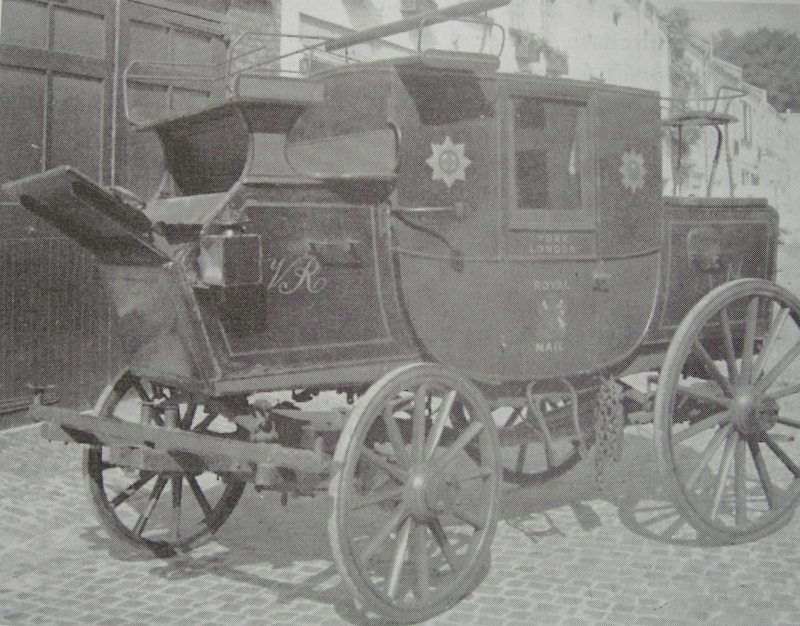
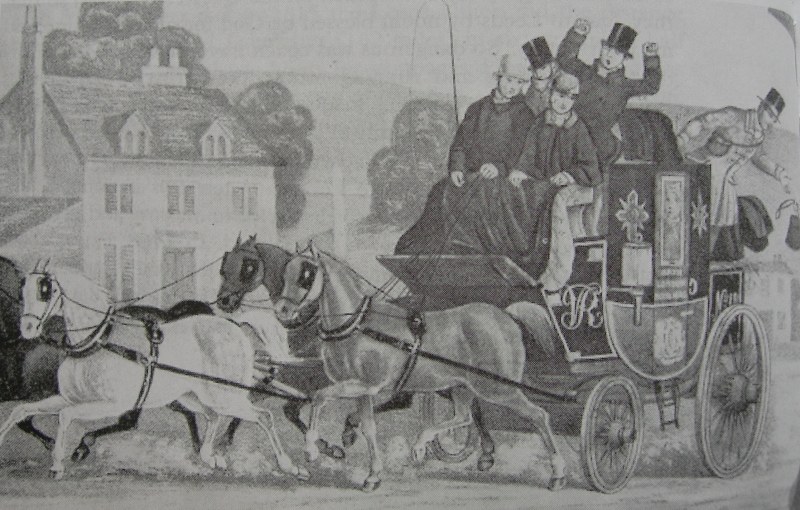
The York to London Mail Coach from 1820 as preserved for
real at the Science Museum and in art collecting the early
morning mail from a village Post Office without
stopping.
Inns and Coaching Houses
Some of the Inns that have connections with the coach services that passed through the village.
The White
Horse /Old White Horse Inn, Boar Lane, Leeds 1792-1840
This old inn had
connected with the heavy luggage waggons long before it started with coaching.
One or two minor coaches ran from here in 1792. One of these coaches was called
the Eclipse, and ran on alternate days to Scarborough; the other was the Packet,
which ran between Leeds and Bingley every Monday, Wednesday, and Friday, leaving
the White Horse at nine in the morning,
The
Commercial Inn/Hotel and Coffee House at the corner of Nessgate, Castlegate, York.
( Commercial Coffee House, Low Ousegate)
It was named the Commercial Coffee House in February
1824 by Thomas Waite.Thomas committed suicide in his bedroom after 1824,and it
passed to James Douglas, who was acknowledged to be one of the best drivers on
the road. He was a quiet retiring little man, rather inclined to stoutness, with
round, contented features, very abstemious, would never go beyond the single
glass he allotted himself. His style of driving was the very opposite of Tom
Holtby's (another celibrated coachman). There was no display or ostentation about it, but it
rather partook of skill and science of the quietest and most finished kind. The
Royal Umpire left here for Leeds every afternoon at four, and another Royal Umpire
left at the same time every Tuesday, Thursday', and Saturday for Malton. These
coaches were horsed by Isaac Robson and T. Raper, and were afterwards removed
to the White Swan. It was a house with many changes of name starting about 1748
as Harrison's Coffee House and in 1785 the landlord, Bernard Watson was 'pleased
to advertise his gravy and pease soup'. By 1787 it was the Coffee House and in
1812 The Coach and Horses. Following on from its time with Mr Waites it was Ellis's
Hotel between 1834 and 1843 when it reverted to The Coach and Horses until it
was demolished in 1904 to allow Nessgate to be widened for the passage of electric
trams.
| Tom Holtby died on the 1 June 1863 at the age of 72. He started his career in coaching as a stable lad at the Rose and Crown in Easingwold before advancing to a post boy and then box on a cross country coach where his skills with a whip gained him a place on the London to Edinburgh High Flyer and finally the mail coach. He was the driver of the last mail coach from Edinburgh to York in 1842 when the coach flew a black flag from its roof. A thrifty outlook left him comparatively wealth and in spite of losses through unfavourable investments he left in excess of £3000 at his death. |
The Old Sandhill
Inn, Colliergate, York.
Previously The Sandhill the name was changed in
1742 when the landlord, William Barwick, moved to The White Swan between Petergate
and Goodramgate and renamed that house The White Swan and Sandhill. It was reached
by a narrow passage between the shops in Colliergate. In coaching times (undated
but could be as late as 1828) it was kept by Mrs. Monkman, who, in conjunction
with Isaac Robson, horsed the Leeds and Scarborough coaches, the Royal Umpires,
from this inn from whence there also ran a pair-horse diligence, driven by old
Tommy Raper, every Tuesday, Thursday, and Saturday, for Malton and Scarborough.
It was puchased in 1869 by the York Rifle Corps and two years later they built
a new drill hall on the site.
Talbot
Inn, Scarborough 1754-1770
Mr. Cais ran this inn.
Thomas Spink's, painter and undertaker, Kirkgate, Leeds 1754-1760
The
Post Chaise, Briggate, Leeds 1760-1770
Mr. Joseph Child's ran this inn.
Star
and Garter Inn, corner of Duncan and Call Lane, Leeds 1781-1790s
The Star
and Garter started on the 21st of May 1781 with one of the early London coaches,
the True Briton. The house at that time was kept by Mr. Strickland, who horsed
the True Briton, one stage out of Leeds. Mr. Strickland died around 1787 and his
widow carried on the business until 1789 when her near neighbour, Mr. Hick, of
the Old King's Arms, began to horse the True Briton coach running it from each
house alternately, but before the end of the century it was fully transferred
to Mr. Hick.
The White
Horse, Coppergate, York 1754-1834
The White Horse was one of the
oldest inns in York, in existence long before public coaches began to run.
In 1733 it was a place where common carriers could be found. In 1754 Mrs.
Roscoe kept the house and Mr Wrigglesworth provided horses for the
coaches. In 1802 Mrs. Elizabeth Roscoe sold the White Horse to her niece,
Mary Coates, who had long assisted her in the business; and in more recent
years Mrs. Mary Sowerby kept the inn, Mrs Sowerby horsed the Royal Union
Sheffield Coach, which had moved from the Swan and Tavern, on the
Tadcaster stage. This coach also ran to Scarborough at two in the
afternoon, and Mr. Charles Palmer who had his coach office in the White
Horse yard, where he stood his horses, horsed it, in conjunction with Mr.
Abraham Braithwaite, on the first stage to Scarborough. (thinking of the brockfield book could the parents of the
Braithwaite at the Fox been this person?).
JW Craven
the York confectioner later owned the property and it closed in October 1968 and
was demolished to make way for the Coppergate Development.
The
Talbot Inn, Briggate, Leeds 1781-1790s
The Talbot Inn was originally the
private residence of a family named Simpson, whose last male heir died there in
1670. Ten years after that date a Mrs. Elizabeth Simpson (probably his widow)
was keeping the Talbot Inn. It was one of the oldest and best of the Leeds inns,
although it can only be reckoned as one of the minor coaching houses. It was a
very ancient dwelling, and In the year 1700 the front part of the building facing
Briggate was converted into shops so that after this date the Talbot, like the
Rose and Crown and the majority of the inns off Briggate, was virtually up a yard.
The sporting element of the Talbot was very strong in the last century. It was
the great centre for the "cockers" of Yorkshire, and during the race
meetings on Chapeltown Moor the Clerk of the Course took up his quarters there
where entries for the races were received and the handicaps framed. In 1781 it
was kept by Mr. Christopher Topham who horsed both the Scarborough and Hull diligences.,
Mr. Topham died in 1788, and his widow afterwards carried on the business for
a number of years. Then came Mr. James Jeffreys, who in turn was succeeded by
Mr. Joseph Cawthorne. Coaching was only carried on in a very irregular way from
the Talbot. The Inn is no more and by 1889 the site was occupied by Thornton's
Arcade.
The New Inn,
Scarborough 1781
Mr. Stephens kept this inn,
The
Golden Lion, at the bottom of Briggate, Leeds 1781-1843
This hostelry
was possibly the most successful from a remunerative point of view of the Leeds
coaching houses. The bulk of the coaches that were worked from this house became
established concerns and there was less chopping and changing than at any of the
rival inns. It speaks volumes in favor of their steadfast system that the first
two coaches that were put upon the road from this house were the last two to leave
it. In April, 1781, Mr. Samuel Vincent then landlord of the Golden Lion, worked
on the first stage in and out of Leeds a new London diligence, which ultimately
devolved into the Rockingham, one of the oldest and most popular coaches on the
road; and a few months later he established the Old True Blue Scarborough coach
and the Hull diligence. In December 1791, Mr. Vincent died, and was succeeded
by his bookkeeper, Mr. William Wade, who for a number of years had acted in that
capacity. His term of office however, was not a lengthy one, for he died in February
1799, leaving his widow, Sarah Wade, to carry on the business. From 1803 to 1809
Mr. Richard Rhodes controlled the establishment, and then it passed into the hands
of Mr. William Lee, in whose family it remained throughout the best part of the
coaching era. In 1823 Mr. Lee took his son Tom into partnership with him, and
he, after his father's death, which occurred in 1836 at his residence at the corner
of King Street and Wellington Street, carried on the business until it passed
into the hands of the Rollings, of the White Horse, in 1842.
The
Old King's Arms, Briggate, Leeds 1760-1792
First coaches ran in 1760 when
kept by Richard Cooke, and five years later by his widow, Mary. She was succeeded
around 1780 by Mr. William Wood. The coach office was situated in Currier Yard,
in Mr Cooke's time the clerk in charge was Richard Blackhouse. John Hick succeeded
Mr. Wood.
|
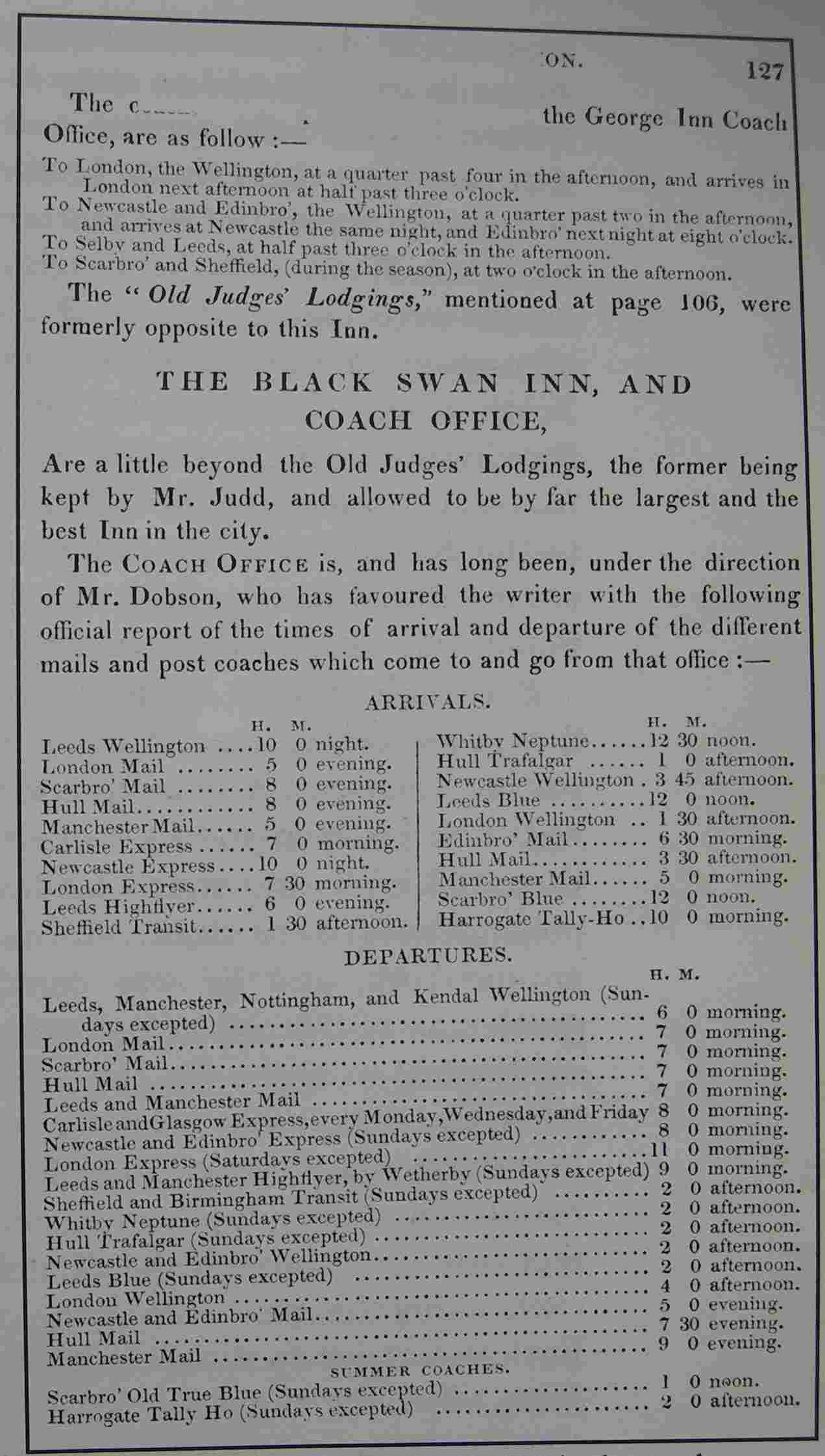
The Black Swan in Coney Street, York 1706-1800s It was first mentioned in 1663. During the coaching days the Black Swan often worked in conjunction with the York Tavern. It was the older house of the two and while it wasn't the oldest of the city's coaching inns, it was the first to run regular coaches. A coach service to the Black Swan, Holbourn started from here on 12 April 1706, the journey taking 4 days.
York Four Days Stage Coach Begins on Friday the 12th of April 1706. All that are desirous to pass from London to York, or from
York to London, or any other places on the road, let them
repair to the Black Swan in Holbourn in London, and to the
Black Swan in Coney Street in York. At both which places, they
may be received in a stage coach every Monday, Wednesday and
Friday, which performs the whole journey in four days (if God
permits). And sets forth at five in the morning... Allowing
each passenger 14lb weight, and all above 3d a pound.
Performed by Benjamin Kingman, Henry Harrison, Walter
Baynes.
This was a time when there were no more than
half-a-dozen coaches on the road in the whole of Yorkshire. In
1701 Mr. Harding was the landlord, and when the Mails first began to run in 1786
Mr. F. Wrigglesworth, who horsed some of the old coaches, or diligences as they
were then called, in conjunction with other proprietors, kept it. Shortly after
this time Mr. Wrigglesworth left the house for the George on the opposite side
of Coney Street and was succeeded by Mr. Batty, who in turn was followed by Mr.
Clarke, and the house was at that time known as Clarke's Hotel. Mr. Clarke died
here, and his widow carried on the business until she married Mr. James Barber,
who had the longest and most extensive connection with the Swan, and was the best
known of its occupants in connection with its coaching history. Mr. Barber had
previously been silversmith carrying on business close adjoining the Swan. Mr.
Barber and Messrs. Cattle & Maddocks worked a great deal together, and had
almost a monopoly of the coach and mail business, which was of so extensive a
nature that after a time Mr. Barber gave up the management of the inn to Mr. Judd,
and took up his residence at Tang Hall, near York; but he retained the long rows
of stables which bordered each side of the yard, and still continued to horse
the coaches. Mr. Barber had one hundred and thirty horses at the Black Swan. |
In 1820s over 130 horses were stabled here. In 1840 there were 20 coaches a day but by 1842 mail coaching was coming to an end due to the advent of the railways. By 1902 there was only accommodation for 30 men and stabling for 30 horses though it was still used by travellers. The inn closed on 4 April1939. During WWII there was an amusment arcade in the back yard down a concrete lane beside the pub. No record of use until demolished in 1968.
|
York Tavern,
St. Helen's Square, York 1800s
Opened in 1770. It was
known for a short period as The Royal Sussex Hotel after HRH the Duke of
Sussex stayed here in 1841. Shortly after 1850 it was named Harker's York
Hotel by new owner Christopher Harker, at one time butler to Colonel Harry
Croft of Stillington, and the name was retained after his death on 22 June
1870, although the York Tavern was always its official name. It was
demolished in 1929 to enlarge the square. This Inn ajoined the Post Office
and the first Mail coaches started here. Mr Pulleyn was the landlord then
and he was followed by Mr Simpson who kept the establishment until the end
of the coaching days, selling to Christopher Harker, who had kept the
White Swan in the latter part of the coaching days.. Mr Simpson had
nothing to do with the Mails or coaches although he did keep a few horses
to run a cab or two for his customers or commercial gentlement. The coaching business was
run by Messers Cattle and Maddocks who controlled the Taverns stables of 130 to 150 horses.
The entrance to the stables was through a wide archway at the opposite corner
of the Inn to the church. Up this yard were the coach offices, while the
post office was only a few yards away on the low side of St. Helen's
Square, which was convenient fo rthe Mails when changing horses.
The Bell and Bull, Scarborough. 1800s
The
Bull and Mouth, Leeds. 1800-1840
The Bull and Mouth has always been more
or less connected with " the road," and for years before it became a
coaching house, when it was known by the sign of the Old Red Bear, it was one
of the great centres for the heavy luggage waggons. The old stage waggon, the
forerunner of the stagecoach, with its long team of eight or ten powerful horses
and its huge pile of baggage, was common enough on the road in the old coaching
days. In those days the high archway at the Bull and Mouth was almost double its
coaching width, to allow of the ingress and egress of the great bulky waggons,
piled high with merchandise. When the coaches began to run from the house in 1800
a portion of this passage was built up, and converted into a coach-office. Mr.
William Ward kept he house and firmly established it as a coaching house. Among
the coaches that he was instrumental in introducing was a Scarborough season coach.
Mr. Ward worked some of the coaches in conjunction with Mr. Rollings, of the White
Horse, but the compact was broken in August 1819. Mr. Ward's coaching experience
at the Bull and Mouth extended over almost the first quarter of the century, and
he was succeeded in 1823 by the only other coach proprietor that had any connection
with the house, and whose term of office lasted to the end of the coaching days.
This successor was Mr. Mathew Outhwaite, but his occupancy was confined purely
and simply to the cellar stables and the coaching business. The landlord who succeeded
to the house was Mr. Uriah Bulmer, but he had nothing whatever to do with the
coaches. Mr. Outhwaite was undoubtedly the most enterprising of the Leeds coach
proprietors, and his advent at the Bull and Mouth was quickly followed by a long
array of new coaches and a succession of crowded stables. Besides his stables
at the Royal Hotel, the White Horse Yard, and Bank Street, there would be standing
room for thirty horses in the cellar stables at the Bull and Mouth. These stables,
like those at the Royal, were below the level of the yard, and were approached
by a sloping subway. The yard stables were used by the hotel for their own post
- horses. Mr, Outhwaite would have about two hundred horses altogether. He did
not reside at the Bull and Mouth, but lived in New Leeds, where he rented a farm
under Earl Cowper known as Squire Pastures, and where he turned his horses out
to graze. He was in appearance a short, stout, fresh, comfortable looking man,
and a good and kind master. He was probably the last of the Leeds coaching proprietors,
and fought hard to the end against the railways. In 1840 there were only eight
coaches running from the Bull and Mouth and Royal Hotel, all horsed by Mr. Outhwaite;
this shows a sad falling off from ten years earlier, when there were over four
times that number leaving these two inns daily. The fate of coaching being irrevocably
sealed, Mr. Outhwaite, with his large contingent of horses idle on his hands,
was obliged to find occupation for them, so on the 23rd of November, 1840, he
entered upon the premises lately occupied by the Widow Welsh, whose waggon warehouse
was situate in Bank Street, and working in immediate connection with the well-known
firm of Chaplin & Home, began to carry goods to all parts of the kingdom,
although he still continued to horse a few coaches for some years after this date.
White
Swan, Pavement, York. 1816-17
In 1733 a place where common carriers could
be found. Mrs. Hardcastle kept The White Swan in the earlier part of the 19th
century. She retired from this coaching inn to Calm Cottage on the Malton Road,
where she died, and Mr. Woodhead kept it in the latter part of the old coaching
days. One of the coaches that ran from here in Mrs. Hardcastle's time was the
York and Sheffield Accommodation coach, every afternoon at half- past one, which
ran to the King's Head, at Sheffield. Mr. Robinson stabled his horses here, and
horsed this coach on the Tadcaster stage, and at one time horsed the Sheffield
baggage waggons. The Royal Union was a Leeds and Scarborough coach, which left
the White Swan daily for both places. There was another Royal Union post coach,
which ran from this house in Mr. Woodhead's time to Mr. Lewis's, Humber Tavern,
Hull. It was demolished during construction of the new street, Piccadilly and
rebuilt in a much larger scale in 1912. It closed for businesss in 1990.
General Coach Office, Coney Street; York. 1816-17
George
Hotel , Coney Street, York 1700-1792
Built as the George and Dragon on
a site previously occupied first by The Bear and then The Golden Lion which had
gone by 1596. It probably became the George around 1604. It was mentioned in a
poem by John Taylor in 1622 and in 1688 in John Webster's diary. In 1736 it was
one of the three principal inns in the city. It was a very old building with a
spacious quadrangle, and had a most curious porchway to its wide gateway, which
was embellished with several fine bosses. This always held the position of being
the principal posting house in the city, and as early as the year 1700 we find
that Mr. Jubb had the stabling, and kept post-horses there, although at that early
date there would be no coaches running from the house. The property was later
held by Mrs. Winn, and kept eight or ten postboys, the principal of whom were
old George Gill and Tiplady, and had a monopoly of almost all the posting houses
between York and Scarborough. Towards the end of the coaching days Mr. Abraham
Braithwaite kept the George, but he afterwards removed to the Black Swan. A coach
called the Highflyer used to run from here to the Blacksmith's Arms at Scarborough
daily, and at one time another Scarborough coach was horsed from the George by
Tom Poole, who afterwards moved to the Greyhound. It struggled as a commercial
hotel after 1839 with the coming of the railways and by 1866 it was closed and
sold as five lots, which mainly became shops. A plaque now commomorates the building
on the outside of Next.
The Union Inn, Briggate, Leeds. 1834
The Blacksmith's Arms, Scarborough 1828-1835
The
Rose and Crown, Biggate, Leeds 1783-1845
The Rose and Crown stood in its
own yard, at the Back of the Shambles, Briggate, where the Queen's Arcade now
stands. Prior to the coaching days its chief and earliest characteristics have
always been more or less of a sporting nature and like its neighbour, the Talbot,
it boasted a cock-pit In its early days.
As a coaching house it has always
been more or less connected with the Mails, and Mr. Palmer's efforts to transfer
the carrying the mails to the
Coaches. Probably the first coach, which ran
from the house, was the Defiance, which commenced in 1783, and ran between Leeds
and Hull. At this time the house was kept by Mr. Joseph Hindle, who succeeded
Mr. John Smith, one of the first of the Leeds coachmen, who died on the 6th of
September 1770. Mr. Hindle rapidly extended his posting business, and his son
entering into partnership with him at a later period, they contracted for the
Liverpool, Scarborough, and Whitby Mails when they first began to run, which were
worked from this inn to the end of the coaching days. About 1806 Mr. John Hogg
succeeded the Hindles at the Rose and Crown, but he only took over a portion of
the increasing coaching business as Mr. William Musgrave occupied part of the
stables, and worked a number of coaches from the same place. Around 1812 Mr. Hogg
took the whole business into his own hands, although at various periods he let
off some of his stables to other coach proprietors, including in 1818, Mr. Harwood
who horsed the Hull Mail and the Prince Blucher Scarborough coach from the Rose
and Crown stables. During the twenty years that Mr. Hogg occupied the Rose and
Crown he more than doubled the number of coaches and when, in 1826, he was succeeded
by Mr. John Frances, the mail and stage coach connection was second to none in
the town. Within a few years of his succession Mr. Frances was joined in partnership
by Mr. Thomas Coates, and this order of things continued until 1836, when the
whole of the Rose and Crown coaching business fell into the hands of Mr. Coates,
who held it to the end of the coaching days.
The
Rose and Crown, Tadcaster,
True Briton and the Prince Blucher change horses
here, a fifteen mile stage from Leeds.
The Hotel Inn, Briggate, Leeds later the Royal Hotel.
The Angel, Whitby 1832-1833
The
Greyhound, York
Tom Poole kept this inn after he left the George. (5
inns of this name in York at the time)
The
Elephant and Castle Inn, Skeldergate, York Early 1800s
The Elephant and
Castle was in business by 1727. Kept early in the 19th century by Mr. George Flower,
who was succeeded by Mr. Taylor, and the following coaches were worked from this
inn: the Yorkshire Hussar (York and Ripon), the Harrogate Union, the Recovery
(Leeds and Scarbro'), the Wensleydale Umpire, and the Hull Union before it was
transferred to the White Swan. When sold in 1882 it had its own brewhouse. Demolished
in 1958.
King's Arms,
Fossgate 1812-1845
Open before 1764 and known for a period around 1774
as the Old King's Arms. It had its own brewhouse when it was sold in 1876. It
closed on 30 November 1936.
Robin Hood, Castlegate, York
The Pack Horse, Micklegate, York
The Golden Lion, Monk Bar, York
Etteridge's Hotel, Lendal,
York
While not
involved with the regular coaches they did provide relays of horses for
nobility and gentry travelling in their own private carriages. 'Tommy'
Edderidgewas a noted figure around Yorkand considered a character in
his day. A gentleman of the old school, courteous in manner and precise
and methodical in all he did , he gained the respect of all his fellow
citizens. It was his habit to make a daily round of the city in his high
gig, which he completely filled having weighed nigh upon twenty four
stones, regularly passing through the Sambles and alon the Market Place
exchanging courtesies of the day with Tradesmen and others. In the evening
he would meet other kindred spirits at the Punch Bowl to discuss the daily
news gathered from numerous coach guards and others. Tommy lived here all
his life, keeping around 40 horses in the stables behind the
Inn and died here long after coaching had ended.
Return to Stockton
While it is currently believed that Stockton was not a staging post, and so did not see the busy scenes alive with a constant whirl of bustle and excitement, with the constant arrival of coach and chaise, the incoming of Mails, the hurried changing of the horses, the hauling about of heavy luggage, the rushing to and fro of excited travellers, common at these places it was probably transferred from rural simplicity to the commotion of a main highway as the above and private traveling carriages, noblemen's equipages, the lumbering heavy luggage and fish waggons, drivers, horsekeepers, postboys, coachmen, and a multitude of hangers-on, not to mention the great droves of cattle and other animals periodically going to and fro, all will have passed through the village at least until 1816 when the new road to Scarborough was opened.
Back to the anecdotal evidence. So far nothing has been seen to suggest that Stockton was a staging post for any stagecoach and the village's distance from York would suggest that it was not far enough out to have been one.
However
in the 1841 Census the Fox is being run by William Braithwaite. Around this time
Abraham Braithwaite kept the George Inn, York and provided horses for coaches.
Could William have been his son?
Could he have stabled a few horses for his
father or as coaching was coming to an end could he have been disposing of unwanted
stock?
Could the old book have been misread/misremembered - could it have
been around 1840 not 1640?
Research will need to be done
- William was born around 1799 at Wilton according to the Census - his father's
name would be a great start.