WARTHILL SIGNALBOX
No records have been found about the method of signalling in place before the signalbox was built, or what protection was provided for the signalman/crossing keeper. The Railway Clauses Act of 1863 required railway companies to erect and maintain a lodge at each rail crossing so it is presumed that there was at least a wooden hut.
The Warthill Signalbox is a Type NE S1a, and from the
details of other similar S1a signalboxes, Grosmont and New Bridge on the
NYMR and Kirkham Abbey, it was probably built between 1873 to 1876 during
the major upgrade to block working and interlocking signals. The station
track and box was upgraded as part of the resignalling of the York &
Beverly line in 1890 by The Railway Signal Co. who used equipment
manufactured to McKenzie & Holland designs. A 1890 design 16 lever
frame was fitted alongside the window with the level crossing gate wheel
at the crossing end. This frame was replaced around the time the crossing
barriers were introduced in1952. The new frame had 20 levers and a new
wheel and was fitted to the back wall of the box. Block
post; sections were to Earswick and to Stamford Bridge in 1960.
It was built of brick, stone and timber with a tiled roof. The brickwork is English Garden Wall bond with three courses of stretchers for every course of headers.
The upper level has prominent brick corner pillars, corbelled out from the main walls from operating room floor level up to the eaves, which then continue as a stepped bricks feature on the gable ends up to the apex of the roof. The operational floor is about 9 feet above rail height with the lower level of the windows about 3 feet higher.
The operating room windows are let into the masonry, which with the effect of the pillars made them seem recessed although they are in fact fitted flush with the main wall line. These windows are three panes deep with a 50in depth. This was one of the few boxes that had continuous glazing at the front. The box has a large window at the level crossing end. The split sill and different sized windowpanes are due to the blocking of the original door and moving of the entrance steps to the other end of the box.
During its working life it was fitted with an outside balcony to permit outside cleaning of windows and to acted as repositories for paraffin hand lamps for hand signalling purposes which were continuously lit after dark for Rules purposes, such signals, being given outside the box, being hand held. Photos show a rudimentary handrail fitted as far back as 1909 but some earlier photos of other boxes don't have them. Were we advanced in H&S?
The original steps to the signal box were at the York end. The door was at the back of the window area with a single slope down the end wall to the front of the building. Its assumed that this was because it was the nearest exit to the crossing gates which may have been manually operated at the time. The steps were moved to the other end of the box sometime between the 1930s and 1950s, possibly when the new frame was fitted at the back of the box. The new entrance door to the box opened on to a landing, the width of the flight of nine steps up to it. The steps jut out at 90° from the wall.
The name board was of wood with separate cast letters screwed to it within a decorative wooden frame.
It is understood that the signalmen were not provided with their own lavatory and that they had to use the station's extremely basis facilities, choosing their times carefully so as not to miss the call of the block bells.
Most boxes were 11ft 6in to 12ft wide. The overall length of the box was determined by the overall length of the frame with additional space at each end.
The operating room would have been set out like all signalboxes with the lever frame, surmounted by a board which gave the description of points or signals operated, the locking being indicated on each individual lever, either by paint or separate plate. Lever tops were normally of polished steel, lovingly tended by the signalmen, electrical control levers having shortened lever tops to mechanical control levers. Over the frame was the block shelf, upon which rested non-token instruments, signal repeaters, track circuit indicators, block switches, point indicators etc. With the advent of electric locking, this fitment over the levers took the form of an illuminated diagram.
In mechanical boxes, the block shelf was surmounted by a layout diagram showing the position of all signals, points, etc., controlled. This was normally in a glazed frame suspended from the roof. A gradient profile of the section(s) of line on either side of the box was usually nearby.
Train movements were recorded in the train register book, which reposed on a sloping top desk, usually with cupboards underneath, on the opposite side of the box from the lever frame. An accurate mechanical clock, regulated daily, was within easy sight of the signalman and lockers were supplied for each person in the box.
There is no sign of a chimney being part of the building so heating was probably provided by a coal or wood burning stove using the metal chimney pipe that can be seen in some photos. Whatever the appliance it was not only for the benefit of providing heating and cooking facilities, but also to prevent dampness, as this was liable to affect the efficient working of electrical equipment and also to cause rusting in the interlocking apparatus.
The station was using paraffin lighting well after WWII so this was probably the main source during the box's working life.
Kept in the room underneath the operating floor level was the interlocking equipment, which took up most of the available space. Signal and point connections passed through an aperture in the wall of the signalbox just above ground level, and then under the platform to the edge of the rail track. The direction of rodding or signal wires was then altered by wheels, cranks, etc., bolted to a wood beam inset in the ground, to pass in both directions up the line to the relevant signals and points etc.. The blocking system sections controlled by the box were to Earswick and Stamford Bridge. They also controlled the yard and released the Warthill Road crossing.
The windows in the lower section to the locking room were tall and narrow with semi-circular heads measuring a standard 24in across by 48in high to the top of arch. They were provided for the assistance of signal fitters and others whose duties involved locking checks, but as a rule these were frequently neglected becoming dirty and losing their practical use. It is assumed that as in most boxes a rather crude workshop type of facility existed for the use of Signal & telegraph Department staff.

In 2008 the signalbox was one of only two of the once numerous signal boxes on the line to survive and the only surviving box to have worked one of the level crossings on the route. After the line had been closed on 29th November 1965 the station building was converted into a dwelling and the signalbox made into a fine garage.
Unfortunately the present owner of the house has allowed the box to fall into a state of disrepair and has been allowed by the local planning department to set in motion a process to turn the box into a blot on the landscape.
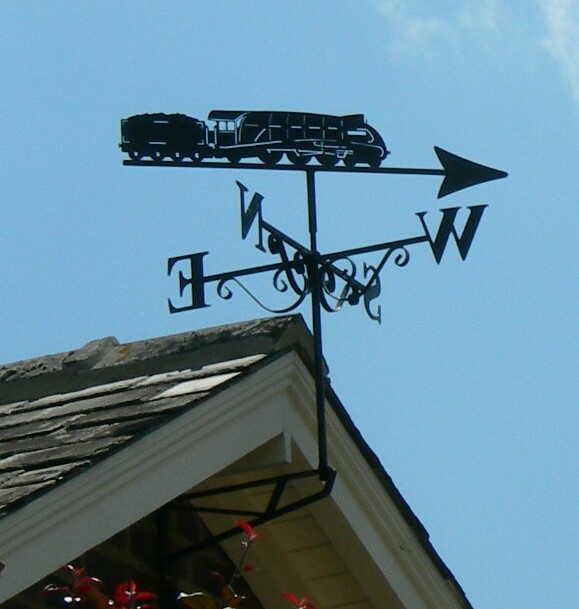
The only good thing about it, is that it stopped the box being demolished and they kept the weather vane! (the vane however is not a period feature and this loco did not run on our tracks)